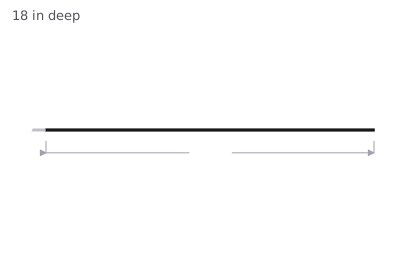
A curb is a prism
Which makes it one of the easier things on this site to calculate and one
of the easier ones to get wrong, because the section is almost never the
rectangle people picture.
section (in²) = average width × height
volume (ft³) = section ÷ 144 × run (ft)
Straight 6 × 18 = 108 in²
Battered (6 + 8) ÷ 2 × 18 = 126 in²
+ gutter 126 + (24 × 6) = 270 in²
Same curb. Two and a half times the concrete.
The two things people leave out
The batter. A curb face leans back, so the section is a
trapezoid and its area is the average of the top and bottom widths — not
either one on its own. Measuring at the bottom over-orders by about a
seventh. Measuring at the top under-orders by about an eighth, and short
is the expensive direction: a curb has to be poured continuously, and
stopping leaves a cold joint in an edge that everybody walks past.
The gutter pan. Curb and gutter is poured
monolithically, so the pan is part of the same section and the same
delivery. On the example below it is 53% of the pour — more
concrete than the curb standing on it. It is the largest single error
available on this page, which is why it is its own profile rather than a
checkbox.
100 ft of curb, before any waste allowance
Straight from this calculator, at an 18 in curb height. Waste is set to zero here so the sections can be compared directly; the tool adds your allowance on top.
Why nothing is prefilled
There is no national standard curb section. Face heights, batters and pan
widths are set by your city or your state DOT, and they differ between
jurisdictions and between road classes inside one. A default here would
be a number your inspector has never seen, so every dimension is one you
enter — off the drawing or the standard detail you are building to.
What it costs
The volume above is ours and it is cited. The rate is yours, and on curb
work more than most, the concrete is the small part: forming, placing and
finishing an edge to a line and a grade is where the money goes, and no
calculator can quote that. Take the volume to the
bags calculator, put in your own
yard and bag prices, and you will have the material side properly. The
guide to bags or ready-mix
covers which way round to buy it — for a curb of any real length the
answer is a truck, because a continuous pour and a bag mixer do not go
together.
Common mistakes
- Measuring the exposed face instead of the section. The curb continues below the gutter line; the height here is the whole section.
- Using the bottom width on a battered curb. About a seventh too much concrete.
- Forgetting the pan. Frequently more than the curb itself.
- Ordering exactly. A curb is a continuous pour with a visible edge. Run out and the joint is permanent.
The rest of the job
The base course under the curb is its own order — the
gravel calculator
handles it from the same run and width. For the flatwork the curb
contains, the slab calculator
does driveways and aprons, and the
bags calculator converts any
volume on this page into bags or yards. Where a curb meets a ramp, the
wheelchair ramp calculator
handles the slope that has to meet ADA.
Common questions
How do you calculate concrete for a curb?
Work out the cross-section once, then multiply by the run. A curb is a prism, so the only real question is the shape of the section: height times width for a straight curb, and for a battered one the average of the top and bottom widths times the height. Multiply that area by the length and you have the volume. Everything else — bags, yards, weight — follows from it.
Why does the batter matter?
Because a leaning face means the section is a trapezoid, not a rectangle, and its area is the average of the two widths rather than either one. A 6 inch top on an 8 inch bottom averages 7. Use the bottom width and you order about 14 percent too much; use the top and you are 12 percent short — and short is the expensive direction on a continuous pour, because stopping leaves a cold joint in an edge everyone can see.
Does the gutter pan really add that much?
More than most people expect: on the worked example below the pan is 53 percent of the pour — more concrete than the curb standing on top of it. A curb and gutter is poured monolithically, so the pan is part of the same section and the same order. Leaving it out is the single largest error available on this page, which is why it is a separate profile rather than an afterthought.
What are the standard curb dimensions?
There is no national standard, and this calculator will not pretend otherwise. Curb sections are set by your city or your state DOT, and they genuinely differ — face heights, batters and pan widths all vary between jurisdictions and between road classes within one. That is why every dimension here is one you enter rather than one that arrived prefilled. Get the section off the drawing or the standard detail you are building to, and put those numbers in.
Is the base course included?
No. This is the concrete in the curb, not the aggregate under it, and they are separate orders arriving on separate trucks. Take the run and the width to the gravel calculator for the base — the ticket links straight to it.
How much does a curb cost?
The volume is above and it is ours to stand behind; the rate is yours. Concrete is priced by the cubic yard delivered and that moves with your region, the month, and the size of the load — and curb work carries labour and forming costs that dwarf the concrete on most jobs, which no calculator can know. Put your own yard price and bag price into the bags calculator with the volume from this page and you will have the material side properly. The forming and finishing is a quote, not a calculation.
Should I use bags or a truck?
Almost certainly a truck. A hundred feet of ordinary curb and gutter is over 6 cubic yards, which is well past the point where bags stop making sense — and a curb has to be poured continuously, so mixing it by the bag means racing a set you will probably lose. Bags are for a short run, a repair, or a section a truck cannot reach. The guide to bags or ready-mix works through where that line sits.
Sources
- Concrete mix density
- 140 lb/ft3
- 80 lb bag yield
- 0.6 ft³
- 60 lb bag yield
- 0.45 ft³
- 50 lb bag yield
- 0.375 ft³
- 40 lb bag yield
- 0.3 ft³
- 90 lb bag yield
- 0.675 ft³
- 30 kg bag yield
- 0.49440533379999996 ft³
- 20 kg bag yield
- 0.35314666699999997 ft³
- Default waste allowance
- 10%
- QUIKRETE Concrete Mix No. 1101 data sheet — published yields of 0.30, 0.375, 0.45, 0.60 and 0.675 ft3 for the 40, 50, 60, 80 and 90 lb bags, the 90 lb noted as regional availability
- QUIKRETE Concrete Mix No. 1101 data sheet — unit weight approximately 140 lb/ft3 per ASTM C138
- Sakrete Concrete Mix product data sheet, King Packaged Materials / Sika Canada — a 30 kg (66 lb) bag yields approximately 0.014 m3 (1/2 ft3)
- Blue Circle Multi-Purpose Concrete technical information, Tarmac — one 20 kg bag typically produces around 0.01 m3 of fresh concrete, supplied throughout the United Kingdom in 20 kg bags
- NRMCA Concrete in Practice CIP 36, Structural Lightweight Concrete — "Structural lightweight concrete has an in-place density (unit weight) on the order of 90 to 115 lb/ft3 (1440 to 1840 kg/m3) compared to normalweight concrete with a density in the range of 140 to 150 lb/ft3 (2240 to 2400 kg/m3)."
Bag yield is approximate and varies with aggregate and water content. Density 140 lb/ft3 is the ASTM C138 unit weight of mixed bagged concrete, about 3,780 lb/yd3, and is what every calculation here uses. Ready-mix delivered by truck is denser, about 150 lb/ft3 or 4,050 lb/yd3; that figure is stored separately as readyMixDensity and appears only where a page discusses ordering ready-mix. The two are not interchangeable. The 90 lb bag is regionally stocked rather than nationally, so it is flagged and listed last. Bag sizes are per market: the 40 to 90 lb bags are what North American merchants stock, and the 20 and 30 kg bags are what the UK, Canadian and Australian ones do. Switching the calculator to metric switches the shopping list with it, because a metric answer priced in pounds of product is not an answer anyone can buy. The 150 lb/ft3 ready-mix figure was carried for a long time as a point value with nothing behind it. NRMCA CIP 36 publishes it as the TOP of a range — normalweight concrete is 140 to 150 lb/ft3, and structural lightweight is 90 to 115 — so densityRanges now holds both and the weight calculator reports a span rather than a single number it cannot justify. Where one figure has to be picked, the top of the range is the safe end: over-stating a weight risks specifying too much truck, and under-stating it risks overloading one.
Unit conversions are exact by definition and need no source.
How we choose and cite these figures