Thinset calculator

Bags from the manufacturer's published chart, by product and by trowel.

Units

Each product has its own published chart. Swap it and the trowel list changes with it.

The trowel is what decides the quantity. Nothing else on this page moves it as much.

Back-buttering and waste

Enter 1 if you are skimming the back of every tile. It is a second application over the whole area.

Why 10%?

Cuts, a bag that goes off before it is used, and the skim you lose cleaning a notched trowel. Five per cent is a starting point, not a published figure.

Material estimate

Enter the area and pick a trowel to see the bags.

    The trowel is the calculation

    Almost every thin-set calculator asks for an area and multiplies it by a single coverage figure. There is no such figure. The notch on your trowel decides how much mortar goes on the floor, and across the profiles one manufacturer publishes for one product line, coverage runs from 100 square feet a bag down to 34. That is a factor of nearly three, on the same floor.

    bags = area ÷ coverage for YOUR trowel, rounded up 200 ft² of VersaBond 1/4 × 1/4 in square-notch 85–95 ft²/bag → 3 bags 1/4 × 3/8 in square-notch 60–67 ft²/bag → 4 bags ProLite, U-notch at 30° 45–50 ft²/bag → 5 bags Same floor. Same area. Different trowel.

    Coverage is measured, not derived

    You cannot work this out from the volume of the notches. Ridges collapse when the tile is bedded, substrates are not flat, and the mortar that ends up on the back of the tile is not the mortar that came off the trowel. So manufacturers measure it and publish it, and this page reads their charts rather than computing a number that would look precise and be wrong.

    Published coverage by product and trowel

    Published coverage by product and trowel
    ProductTrowelCoverage per bagPer poundNote
    VersaBond, 50 lb1/4 x 1/4 x 1/4 in square-notch85–95 ft²1.7 ft² per lb
    VersaBond, 50 lb1/4 x 3/8 x 1/4 in square-notch60–67 ft²1.2 ft² per lb
    VersaBond-LFT, 50 lb1/4 x 1/4 x 1/4 in square-notch90–100 ft²1.8 ft² per lb
    VersaBond-LFT, 50 lb1/4 x 3/8 x 1/4 in square-notch60–67 ft²1.2 ft² per lb
    VersaBond-LFT, 50 lb1/2 x 1/2 x 1/2 in square-notch42–47 ft²0.84 ft² per lbPublished, not recommended
    VersaBond-LFT, 50 lb3/4 x 9/16 x 3/8 in U-notch at 45 degrees34–38 ft²0.68 ft² per lb
    VersaBond-LFT, 50 lb3/4 x 9/16 x 3/8 in U-notch at 30 degrees42–47 ft²0.84 ft² per lb
    ProLite, 30 lb1/4 x 1/4 x 1/4 in square-notch90–100 ft²3 ft² per lb
    ProLite, 30 lb1/4 x 3/8 x 1/4 in square-notch63–70 ft²2.1 ft² per lb
    ProLite, 30 lb1/2 x 1/2 x 1/2 in square-notch45–50 ft²1.5 ft² per lbPublished, not recommended
    ProLite, 30 lb3/4 x 9/16 x 3/8 in U-notch at 45 degrees36–40 ft²1.2 ft² per lb
    ProLite, 30 lb3/4 x 9/16 x 3/8 in U-notch at 30 degrees45–50 ft²1.5 ft² per lb

    CUSTOM Building Products TDS-119, TDS-132 and TDS-114, all published 12 December 2023. Bands are theirs. Note that the same notch covers different amounts of different mortars — which is why these are three charts and not one.

    Buy to the bottom of the band

    A range exists because a flat substrate and a clean pull give you the top of it and a rough one gives you the bottom, and you find out which you have once you are already tiling. So the headline here is the low-coverage end: 4 bags rather than 3 on the worked example. Thin-set has a pot life. Stopping mid-floor to go and buy a bag is not a delay, it is a cold joint in a finished surface.

    The 1/2 inch square notch, and why it is in the chart anyway

    CUSTOM publish a coverage for the 1/2 × 1/2 × 1/2 inch square notch and then tell you not to use it: the spacing between the square ridges stops them collapsing properly when the tile is bedded, leaving voids you cannot see. They recommend a U-notch, V-notch or ridged large-format trowel instead — and their 3/4 × 9/16 × 3/8 U-notch held at 30 degrees gives the same coverage per bag with better contact under the tile.

    Both facts are stored together here, so the tool will give you the number and the warning at the same time rather than one without the other.

    Contact, not quantity

    The requirement that actually governs a tile installation is how much mortar is touching the back of the tile: 80% in dry areas and 95% in wet areas and outside, with the edges supported. That is pass or fail. If you are not hitting it, more bags will not help — a different trowel, a flatter substrate or back-buttering will. Lift a tile early and look.

    What this does not cover

    • Levelling. Thin-set is an adhesive, not a screed. The published bed is 3/32 to 1/4 inch; a dip in the floor is a different product's problem.
    • Uncoupling and waterproofing membranes. They take their own mortar, usually at a different notch, on both sides.
    • Which mortar you need. Large format, natural stone and glass all have their own requirements, and the bag says so.

    The rest of the floor

    The tile calculator counts the tiles for the same area with a waste factor that follows the lay pattern, and the grout calculator reads a published chart the same way this page does — by tile size and joint width, cement or epoxy. If you are tiling a whole room, the room materials calculator gives you the board, compound and paint in one list, and where the tile is going on a wall you have just built, the drywall screw calculator and the wall framing calculator cover what is behind it.
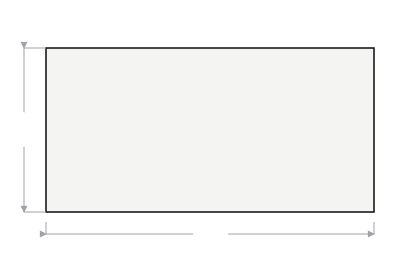
    Plan view of a 200 square foot floor, the area a thin-set coverage chart is read against.
    Drawn to scale.

    Common questions

    How much thinset do I need per square foot?

    There is no per-square-foot figure, and that is the point. Coverage depends on the trowel: the same VersaBond covers 85–95 ft² a bag through a 1/4 inch square notch and 60–67 ft² through a 1/4 by 3/8, and a large-format U-notch takes it down again. On 200 square feet that is 3 bags against 4 — for the same floor. Pick the trowel your tile needs first, then read the chart.

    How many square feet does a 50 lb bag of thinset cover?

    Between about 34 and 100 square feet, depending entirely on the notch and slightly on the product. CUSTOM publish VersaBond at 85–95 ft² through a 1/4 inch square notch and 60–67 through a 1/4 by 3/8. Their large-format mortars differ again at the same notch, which is why this page keeps the three charts separate rather than averaging them into one number nobody printed.

    Which end of the coverage range should I buy to?

    The low end — the one that needs more bags. A published band exists because a flat substrate and a clean pull give you the top of it and a rough one gives you the bottom, and you find out which you have after you have started. On the worked example that is 4 bags rather than 3. A spare bag costs a few dollars; stopping halfway across a floor with mortar going off behind you costs the floor.

    Does back-buttering double the thinset?

    Effectively, yes — it is a second application of mortar over the same area. Skimming the back of every tile on the 200 square foot example takes it from 4 bags to 7. CUSTOM's own instruction is to look at the tile's underside pattern and depth, estimate the thickness that fills it, and add that to your estimate. Big tiles and deep back patterns need it; small tiles on a flat floor usually do not.

    What trowel size do I need for my tile?

    Bigger tile, bigger notch — but the real test is coverage, not the tile size. The requirement is how much mortar is actually touching the back of the tile once it is bedded, and that is a number you check by lifting one. A tile that lifts with mortar on two thirds of its back is failing regardless of what trowel produced it. Warped tiles, deep back patterns and unflat substrates all push you to a larger or differently shaped notch.

    Why does CUSTOM say not to use a 1/2 inch square notch?

    Because the gaps between the square ridges are so wide that the ridges do not collapse properly when the tile is bedded, and you end up with voids you cannot see. Their published note says the spacing "has been shown to make it more difficult to bed tiles and achieve proper mortar coverage", and they recommend a U-notch, V-notch or ridged large-format trowel instead. The 3/4 by 9/16 by 3/8 U-notch held at 30 degrees gives the same coverage per bag with better contact. That trowel is in the chart on this page and it is the honest alternative.

    How much mortar contact does the tile need?

    Eighty per cent in dry areas and ninety-five per cent in wet areas and outside, with the tile edges supported. That is a pass-or-fail requirement rather than an estimating figure, and it is why more bags is never the fix for poor coverage — the fix is a different trowel, a flatter substrate, or back-buttering. Lift a tile early in the job and look at the back. It is the only way to know.

    How thick should the mortar bed be?

    Between 3/32 and 1/4 of an inch once the tile is bedded, for a mortar without an ANSI "H" rating — that is what CUSTOM publish for these products. Thin-set is an adhesive, not a levelling compound: if you are using it to take out a dip in the floor you have the wrong material and you will get lippage, cracking or both. Level the substrate first, then tile onto it.

    Sources

    Three products rather than one average, because coverage differs between them at the same trowel and averaging would produce a figure nobody publishes. Every row is a min-max band exactly as printed. The 1/2 in square notch carries the manufacturer's own recommendation against using it, stored alongside its coverage so the two cannot be separated: the number is real and the advice is theirs. No figure here is derived from a density or a notch volume — a calculated coverage would ignore ridge collapse, substrate profile and back-buttering, which is why manufacturers measure it instead.

    Unit conversions are exact by definition and need no source.

    How we choose and cite these figures

    By Team MaterialMath. Published . How these figures are sourced and checked.