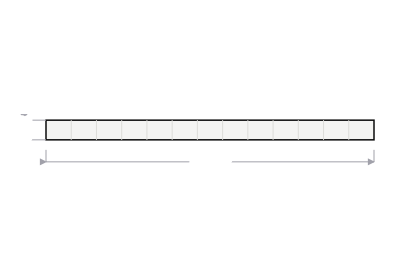
How a fence is counted
A fence is three counts that come from different arithmetic, which is why
estimating one in your head so often produces a short order, and why a
fence calculator that reports a single number is answering the wrong
question.
sections = ceil(length ÷ post spacing)
posts = sections + 1 (+2 per gate)
rails = sections × rails per section
pickets = ceil(length in inches ÷ (picket width + gap))
The end post
Thirteen sections need fourteen posts. Every section starts at a post, and
the run has to be closed at the far end, so the count is always one more
than the number of gaps. It is a small error and it stops the job dead at
the last bay.
The gap decides the picket count
Pickets occupy their own width plus the space beside them. On a hundred
foot solid fence that is 219 pickets butted tight; open the gap to two
inches and it drops to 160. Divide by the picket width alone and you buy
pickets you cannot use — the same mistake the
deck board calculator
exists to prevent on decking.
Common mistakes
- Forgetting the end post. Sections plus one, always.
- Two rails on a six foot fence. It will bow. Three above four feet.
- Ignoring the picket gap. Worth dozens of pickets on a long run.
- Costing shadowbox as solid. It takes about twice the pickets.
- Setting spacing before buying rails. The stock length decides the spacing, not the other way round.
What holds the fence up
Every post needs concrete, and the volume is the hole minus the post
rather than the hole itself — the
post hole calculator does
that subtraction and gives bag counts per hole and for the whole run. If
the ground stays wet along the line, a
French drain beside it
will keep the post bases out of standing water.
Materials for a 6 ft fence at 8 ft post spacing
Computed by this page's own calculator. Pickets are 5.5 in — a nominal 1x6. The last two columns show what the gap is worth across a whole run.
The rest of the fence
Posts have to go somewhere. The
fence post depth calculator
settles how deep each hole goes and how long a post to buy, the
post hole calculator turns
that hole into a bag count, and the
board foot calculator
prices the timber the way a yard quotes it. Running the fence into a
wall? The
retaining wall calculator
covers the blocks and the base.
Common questions
How many rails do I actually order?
Fewer than the rail count, because rails are cut from lengths. At eight foot bays a sixteen foot rail does two of them, so thirty-nine rails is twenty lengths and not thirty-nine. Tell the calculator what length your merchant sells and it does the division. If a bay is longer than the stock it says so rather than quoting a fraction of a length.
What does a gate need besides the posts?
Two hinges and a latch, at minimum, and they are on the list now. A gate adds two posts — which the calculator has always counted — but a fence order that stops there sends you back to the shop for the hardware. A wide or heavy gate wants three hinges rather than two, and a double gate wants a drop bolt whatever it weighs.
How many posts do I need for a 100 foot fence?
Fourteen, at the usual 8 foot spacing. A hundred feet divides into thirteen sections, and thirteen sections need fourteen posts — one at the start of each, plus one to close the far end. That last post is the classic off-by-one in fencing, and it is the one people are missing when they get to the end of a run a post short.
How far apart should fence posts be?
Six to eight feet, with eight the practical maximum for most rail and panel systems. The spacing is not really a preference — it is set by the stock you are buying, because rails come in fixed lengths and pre-made panels come in fixed widths. Pick the spacing your material wants, then let the post count fall out of it.
How many pickets do I need per foot?
It depends on the gap as much as the picket. Butted tight, a 5.5 inch picket gives 2.18 per foot; at a 2 inch gap that drops to 1.6. The arithmetic that matters is the run in inches divided by the picket width plus the gap — dividing by the picket width alone over-orders, in exactly the same way it does on a deck.
What is a shadowbox fence and why does it cost more?
Shadowbox alternates pickets on either side of the rails so the fence looks finished from both sides and the wind passes through. It takes roughly twice the pickets of a solid fence of the same length, which is the trade for having no bad side and no sail effect in a gale.
How many rails does a fence need?
Two up to four feet, three up to six, and four above that. The rails carry the pickets, and a six foot fence with two rails will bow visibly within a couple of seasons. This calculator applies that scale automatically from the height you enter.
How much concrete goes around each post?
That depends on your hole size and depth, and on frost line where you are. The post hole calculator on this site works it out with the post volume subtracted from the hole, which matters more than people expect — a 4x4 in a 10 inch hole displaces about a fifth of it.
Sources
Two different kinds of figure sit here and they are labelled differently on purpose. The published one is Penn State Extension's: a typical line post goes 36 in deep, and corner and gate posts go about 25 percent larger in diameter and often to 48 in. That corroborates what the one-third rule produces for a common fence — a 6 ft fence gives exactly 36 in — and it is the source behind the warning that gate and corner posts are not line posts. The rules of thumb themselves, one third of the post buried and a hole three times the post width, are carpentry conventions with no standards body behind them, and they are marked as such. Neither overrides local code or the local frost line, which is why the calculator refuses to state a minimum depth and lets a frost figure you enter win.
From PS 20-10 Table 3, dry sizes. Thicknesses and widths are separate columns of that table and do not follow the same rule, which is why both are listed: a nominal 2 in dresses to 1-1/2 whether it is a thickness or a width, but a nominal 8 in width dresses to 7-1/4 while there is no 8 in thickness row at all. Boards and dimension lumber also dress differently in thickness — a nominal 1 in board is 3/4, a nominal 2 in dimension is 1-1/2. Green lumber is dressed larger than dry (a nominal 2 in dimension is 1-9/16 green against 1-1/2 dry) because it shrinks as it dries; the dry figures are what you measure on a kiln-dried board at the yard.
Unit conversions are exact by definition and need no source.
How we choose and cite these figures