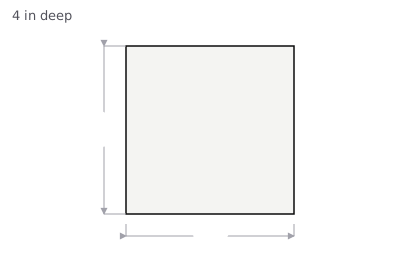
How to calculate concrete for a slab
Thickness is in inches while length and width are in feet, so thickness is divided by 12 before anything else happens. That single step is where most hand calculations go wrong, and it is the whole of what a concrete slab calculator is for.
- length and width — measured in feet, inside face to inside face of the forms
- thickness — the finished depth of the slab, in inches
- 12 — inches in a foot, converting thickness to feet
- 27 — cubic feet in a cubic yard
- bag yield — the cubic feet one bag makes once mixed. An 80 lb bag yields 0.60 ft³
Worked example: a 10 × 10 ft slab at 4 in
Bags always round up. Coming up one bag short mid-pour leaves a cold joint through the middle of your slab.
Why the waste allowance is 10%
It is not padding — the volume genuinely goes missing. A subgrade a quarter of an inch deeper than intended across a 10 × 10 slab swallows two extra cubic feet on its own. Edges over-excavate, concrete spills off the barrow, and a mixer never returns everything you put in. Raise the allowance on rough or sloping ground.
Common mistakes
- Leaving thickness in inches. 10 × 10 × 4 gives 400 cubic feet instead of 33.33 — twelve times too much. If your answer looks absurd, this is why.
- Ordering yards, then buying bags. Knowing you need 1.36 yards tells you nothing about bag count until you divide by the bag yield.
- Rounding bags down. 61.1 bags is 62 bags, every time.
- Assuming bag sizes scale evenly. Check the yield printed on the bag you are actually buying.
- Measuring outside the forms. The concrete fills the inside — easily a cubic foot of difference on a small slab.
When these numbers do not apply
- Sloping ground. This assumes even thickness. On a slope the average depth governs, and it is usually deeper than you think at the low end.
- Thickened edges or a footing. A turned-down edge can add a third again to a small slab. Add it as a separate area.
- Non-standard mixes. Fibre-reinforced, high-early and lightweight mixes have their own yields. Use the figure on the bag.
- Ready-mix ordering. Plants take orders in quarter-yard steps, so round up to the next quarter yard. Ready-mix is also denser than the same volume mixed from sacks — around 150 lb/ft³ against about 140 for bagged — so a weight worked out here will read low against a delivery ticket.
Why the weight says 140 lb/ft³
This calculator works in bagged concrete, so the weight it reports uses the ASTM C138 unit weight of mixed bag mix, about 140 lb/ft³ — roughly 3,780 lb per cubic yard. The 150 lb/ft³ figure quoted almost everywhere is ready-mix delivered by truck, which is a different product with a different aggregate grading.
The difference is about 7%, which does not matter for volume and matters a great deal for anything you are lifting, barrowing or loading onto a structure. Use 140 when you are carrying sacks and 150 when you are taking a delivery. The two are not interchangeable.
Concrete for common slab sizes, at 10% waste
| Slab | 4 in — yd³ | 4 in — 80 lb bags | 6 in — yd³ | 6 in — 80 lb bags |
|---|---|---|---|---|
| 8 × 8 ft | 0.87 | 40 | 1.30 | 59 |
| 10 × 10 ft | 1.36 | 62 | 2.04 | 92 |
| 10 × 12 ft | 1.63 | 74 | 2.44 | 110 |
| 12 × 12 ft | 1.96 | 88 | 2.93 | 132 |
| 12 × 16 ft | 2.61 | 118 | 3.91 | 176 |
| 16 × 20 ft | 4.35 | 196 | 6.52 | 294 |
| 20 × 24 ft | 6.52 | 294 | 9.78 | 440 |
Computed by this page's own calculator at build time. Past about one cubic yard — roughly 45 bags — ready-mix is normally cheaper than mixing by hand.