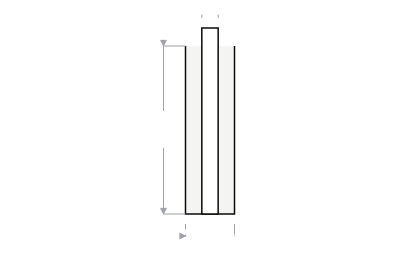
Half the height you can see
The rule is one third of the post buried. Turn that around and it becomes
much easier to hold in your head: whatever stands above the ground, dig
half of it.
total post = above grade ÷ (1 − 1/3) = above grade × 1.5
embedment = total post × 1/3 = above grade ÷ 2
hole width = post width × 3
gravel base = 4–6 in, dug below the embedment
depth used = max(embedment, your local frost depth)
Where the rule stops being enough
One third is a carpentry convention about leverage — it is what keeps a
post from being pushed over. It says nothing about frost. Ground that
freezes expands, and it will lift a post whose base sits inside the frozen
layer regardless of how much of the post is buried. In cold regions the
frost line, not the rule, sets the depth, and this calculator switches to
it the moment you supply one.
Common mistakes
- Taking a third of the fence height. The rule is a third of the post — half again as deep.
- Counting the gravel as part of the depth. It sits below, so the hole is deeper still.
- Buying posts to the fence height. A 6 ft fence needs a 9 ft post before rounding to stock.
- Setting gate posts like line posts. They carry a load the others do not.
The rest of the fence
Once the depth is settled, the
post hole calculator handles
the concrete for any hole size, and the
fence calculator counts the
posts, rails and pickets for the whole run.
Depth, post length and hole width by fence height
The one-third rule only. A deeper local frost line overrides every figure in this table — check your building department.
The rest of the fence
Depth is one decision out of several. The
fence calculator works out
posts, rails and pickets for the whole run, the
post hole calculator turns
the hole you have just sized into a bag count, and the
deck footing calculator
covers piers poured into a tube rather than a post set in concrete. For
the timber itself, the
board foot calculator
prices it as a yard quotes it.
Common questions
How deep should a fence post be?
The carpentry rule is one third of the total post length in the ground. Because the post is one third buried and two thirds standing, that works out at exactly half the height above ground: a 6 foot fence takes a 3 foot hole and a 9 foot post. That is the arithmetic. Whether it is deep enough where you live is a different question, answered by your frost line and your building department, not by a rule of thumb.
Is it a third of the fence height or a third of the post?
A third of the post, and the difference matters. A third of a 6 foot fence height is 2 feet; a third of the total post length is 3 feet. The second is the rule, and it is fifty percent deeper. This is the single most common way the rule gets misapplied.
What is the minimum depth for a fence post?
There is no national minimum, which is why this calculator will not print one as an answer. Published guidance generally sits between 24 and 30 inches, but the figure that governs your job is set by your local code and your local frost line, and in cold regions it is considerably deeper than either. Ask your building department before you dig — it is a phone call, and it is cheaper than resetting a fence.
What if my frost line is deeper than the rule?
Then the frost line wins, and this calculator will use it. A post that stops above the frost line gets lifted by the ground as it freezes and thaws, no matter how carefully the one-third rule was followed. Enter your local frost depth and the answer changes to match it.
How wide should the hole be?
Three times the width of the post. For a 4x4 — which actually measures 3.5 inches — that is a 10.5 inch hole. For a 6x6 at 5.5 inches, 16.5 inches. Wider holes take substantially more concrete, because the volume goes with the square of the radius: doubling the diameter quadruples the bag count.
Do I need gravel at the bottom?
Four to six inches of it, and it goes below the depth this calculator reports rather than inside it. Its job is drainage — water sitting against the bottom end of a wooden post is what rots it. Dig that much deeper than the figure shown, then bring the post back up to the right height on the gravel.
Are gate and corner posts different?
Yes, and meaningfully so. A gate post carries a swinging load all day and a corner post takes the pull of two runs of fence. Both are commonly set deeper and in a wider hole than the line posts this calculator sizes. Treat the figure here as the line-post depth and go beyond it at the corners and gates.
Sources
- Concrete mix density
- 140 lb/ft3
- 80 lb bag yield
- 0.6 ft³
- 60 lb bag yield
- 0.45 ft³
- 50 lb bag yield
- 0.375 ft³
- 40 lb bag yield
- 0.3 ft³
- 90 lb bag yield
- 0.675 ft³
- 30 kg bag yield
- 0.49440533379999996 ft³
- 20 kg bag yield
- 0.35314666699999997 ft³
- Default waste allowance
- 10%
- QUIKRETE Concrete Mix No. 1101 data sheet — published yields of 0.30, 0.375, 0.45, 0.60 and 0.675 ft3 for the 40, 50, 60, 80 and 90 lb bags, the 90 lb noted as regional availability
- QUIKRETE Concrete Mix No. 1101 data sheet — unit weight approximately 140 lb/ft3 per ASTM C138
- Sakrete Concrete Mix product data sheet, King Packaged Materials / Sika Canada — a 30 kg (66 lb) bag yields approximately 0.014 m3 (1/2 ft3)
- Blue Circle Multi-Purpose Concrete technical information, Tarmac — one 20 kg bag typically produces around 0.01 m3 of fresh concrete, supplied throughout the United Kingdom in 20 kg bags
- NRMCA Concrete in Practice CIP 36, Structural Lightweight Concrete — "Structural lightweight concrete has an in-place density (unit weight) on the order of 90 to 115 lb/ft3 (1440 to 1840 kg/m3) compared to normalweight concrete with a density in the range of 140 to 150 lb/ft3 (2240 to 2400 kg/m3)."
Bag yield is approximate and varies with aggregate and water content. Density 140 lb/ft3 is the ASTM C138 unit weight of mixed bagged concrete, about 3,780 lb/yd3, and is what every calculation here uses. Ready-mix delivered by truck is denser, about 150 lb/ft3 or 4,050 lb/yd3; that figure is stored separately as readyMixDensity and appears only where a page discusses ordering ready-mix. The two are not interchangeable. The 90 lb bag is regionally stocked rather than nationally, so it is flagged and listed last. Bag sizes are per market: the 40 to 90 lb bags are what North American merchants stock, and the 20 and 30 kg bags are what the UK, Canadian and Australian ones do. Switching the calculator to metric switches the shopping list with it, because a metric answer priced in pounds of product is not an answer anyone can buy. The 150 lb/ft3 ready-mix figure was carried for a long time as a point value with nothing behind it. NRMCA CIP 36 publishes it as the TOP of a range — normalweight concrete is 140 to 150 lb/ft3, and structural lightweight is 90 to 115 — so densityRanges now holds both and the weight calculator reports a span rather than a single number it cannot justify. Where one figure has to be picked, the top of the range is the safe end: over-stating a weight risks specifying too much truck, and under-stating it risks overloading one.
Two different kinds of figure sit here and they are labelled differently on purpose. The published one is Penn State Extension's: a typical line post goes 36 in deep, and corner and gate posts go about 25 percent larger in diameter and often to 48 in. That corroborates what the one-third rule produces for a common fence — a 6 ft fence gives exactly 36 in — and it is the source behind the warning that gate and corner posts are not line posts. The rules of thumb themselves, one third of the post buried and a hole three times the post width, are carpentry conventions with no standards body behind them, and they are marked as such. Neither overrides local code or the local frost line, which is why the calculator refuses to state a minimum depth and lets a frost figure you enter win.
Unit conversions are exact by definition and need no source.
How we choose and cite these figures