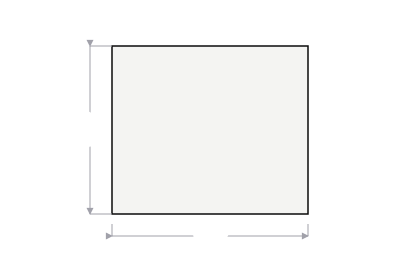
How trim is counted
Trim is bought in lengths, not in feet, and that is the whole difficulty.
The perimeter tells you how much material ends up on the wall; the stock
length tells you how much you have to carry home.
perimeter = 2 × (length + width)
with waste = perimeter × (1 + waste)
lengths = ceil( with waste ÷ stock length )
Worked example: a 12 × 14 ft room
perimeter = 52 ft
with 10% = 57.2 ft
in 8 ft = 8 lengths (64 ft)
in 16 ft = 4 lengths (64 ft), but no mid-wall joints
Both options buy 64 feet. The difference is where the joints land: eight
short lengths put a joint in the middle of nearly every wall, four long
ones put them only at corners, where nobody looks.
Common mistakes
- Buying the perimeter. Fixed lengths and real walls never divide evenly.
- Stock shorter than the longest wall. It puts a visible joint mid-wall for no saving.
- Mitring inside corners. They open as the house moves. Cope them.
- Cutting the longest piece first. Cut the hardest wall first while you still have full lengths to make a mistake on.
- No allowance for learning to cope. The first few joints cost material.
The rest of the room
Trim and panelling usually happen in the same job: the
board and batten
calculator spaces battens so every bay matches, which matters most
where the trim meets them. Painting is easiest before the trim goes up,
and the paint calculator works
out the gallons.
Lengths of trim by room size, at 10% waste
Longer stock usually buys the same total footage with fewer joints, and a joint near a corner is far less visible than one in the middle of a wall.
The rest of the room
Trim is the last thing into a room. The
drywall calculator works out
the board it lands on, the
board and batten calculator
handles the vertical trim that meets it, and the
paint calculator takes the same
room dimensions you entered here. If you are cutting the lengths out of
stock yourself, the
cut list optimizer lays
them out with the least waste.
Common questions
What angle do I set the saw to?
Not 45, if it is crown and you are cutting it flat on the table. A crown does not meet the wall square, so the two settings are a compound: for the common 38 degree spring at a square corner it is a 31.62 degree mitre and a 33.86 degree bevel, and for a 45 degree spring it is 35.26 and 30. Pick your spring angle above and the ticket gives you both, plus the settings for a 135 and a 120 degree corner — which is what a bay window throws up and what the chart on the back of the saw does not cover. If you are cutting the crown standing up against the fence instead, it is a plain 45 degree mitre and none of this applies.
What is a spring angle?
The angle the back of the moulding makes with the wall when it is in place. Almost all stock crown is made at one of two: 38 degrees, which sits 38 against the wall and 52 against the ceiling and is usually sold as 38/52, or 45 degrees, which sits at 45 to both. Hold an offcut against a square and you can read it off in seconds. It matters because it is what makes the cut compound — the settings for the two are several degrees apart, and a mitre cut for the wrong one leaves a gap you cannot fill.
How much crown molding do I need for a 12x14 room?
The perimeter is 52 feet. With the usual ten percent allowance that is 57.2 feet, which is eight 8-foot lengths. Note that eight lengths is 64 feet — you are buying almost seven feet more than the room measures, and most of that surplus disappears into corner cuts and the ends you trim square.
Why can I not just buy the perimeter in feet?
Because trim is sold in fixed lengths and a wall does not care what those are. A 14 foot wall from 8 foot stock needs two pieces and leaves a 2 foot offcut, and that offcut is only useful if another wall happens to need a piece under 2 feet. Dividing the perimeter by the stock length is the arithmetic; buying whole lengths is the shopping list.
Should I cope or mitre inside corners?
Cope them if you can. A mitred inside corner opens up as the house moves and the joint shows as a dark line within a season; a coped joint hides that movement because one piece sits against the profile of the other. Coping wastes slightly less material too, since only one piece of the pair is cut at an angle.
How much waste should I allow for trim?
Ten percent is the working figure for a straightforward rectangular room, and this calculator uses it. Add more if the room has many corners, if the molding has a pattern that has to line up across a joint, or if you are new to coping — the first two or three coped joints usually cost a length between them.
What length stock should I buy?
Long enough to cross your longest wall in one piece if you possibly can. A joint in the middle of a wall is visible from across the room no matter how well it is cut, whereas a joint tucked near a corner is not. If the longest wall is 14 feet, 16 foot stock costs a little more and removes the worst joint in the room.
Does this work for baseboard and chair rail too?
Yes. The arithmetic is identical for anything that runs around a room in fixed lengths — baseboard, chair rail, picture rail, shoe molding. The only thing that changes is whether you deduct door openings, which for baseboard you should and for crown you should not.
Sources
This calculator uses no material constants — only geometry and unit
conversions, both exact by definition. Nothing here depends on a
supplier's published figure.
How we choose and cite these figures