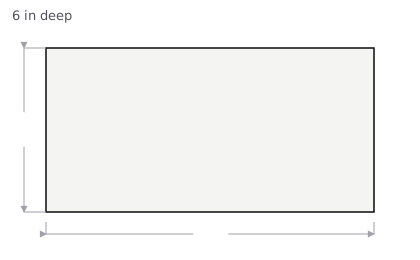
Divide the depth by twelve first
That is the whole difficulty. Length and width come in feet, depth comes
in inches, and the two have to be in the same unit before anything is
multiplied. Skip it and the answer is twelve times too big — which is
obvious once it is said and is still the commonest error in this
arithmetic.
ft³ = length (ft) × width (ft) × depth (in) ÷ 12
yd³ = ft³ ÷ 27
20 × 10 ft at 6 in deep
20 × 10 × 0.5 = 100 ft³
100 ÷ 27 = 3.7 yd³
A cubic yard is 27 cubic feet. Nine is the SQUARE yard.
Twenty-seven, not nine
A yard is three feet, so a cubic yard is three feet in every direction:
3 × 3 × 3 = 27. Nine is the square yard — 3 × 3 — and reaching for it by
mistake is the second commonest error here. If a figure looks like it is
out by a factor of three, this is almost always the reason.
Cubic yards by area and depth
From this calculator. Depths chosen to match how material is actually spread: 2 in of decorative cover, 4 in of base, 6 in of fill, 12 in of imported soil.
A circle is not the square around it
It is 79 per cent of it. A 10 foot round bed is 78.54 square
feet against the 100 of a 10 foot square, so treating one as the other
over-orders by more than a fifth. The tool has a circle mode for exactly
that reason, and for awkward shapes the honest method is the one used on
site: break it into rectangles and circles, work each, add them up.
This page has no opinion about weight
Deliberately. A cubic yard of screened topsoil is under a ton and a cubic
yard of traprock in the ground is over two and a half, so a volume
calculator that quoted tons would have to pick a material for you. The
volume here is exact; the conversion to weight needs a published density
for the specific material, and that lives on its own page.
Where the volume goes next
To turn yards into tons for a named material, the
cubic yards to tons calculator
publishes sixteen densities with their sources. For a specific job, the
dirt calculator,
mulch calculator and
gravel calculator
all carry the material-specific allowances this page has none of —
compaction, settling, and bag against bulk. For a shape rather than a
material, the pool volume calculator
handles sloping floors and the
square footage calculator
adds up awkward areas before you ever get to a depth.
Common questions
How do you calculate cubic yards?
Multiply length by width by depth to get cubic feet, then divide by 27. The catch is that depth is almost always quoted in inches while length and width are in feet, so the depth has to be divided by 12 first. A 20 by 10 foot area at 6 inches deep is 20 × 10 × 0.5 = 100 cubic feet, which is 3.7 cubic yards. Skipping the division by 12 makes the answer twelve times too big, and it is the single commonest error in this arithmetic.
How many cubic feet are in a cubic yard?
Twenty-seven. A yard is three feet, and a cubic yard is three feet each way — 3 × 3 × 3. The number people reach for by mistake is nine, which is the square yard, and mixing the two is the second commonest error here. If a figure looks like it is out by a factor of three, this is usually why.
How do I work out cubic yards for a circle?
Same as anything else once you have the area: π times the radius squared, then multiply by the depth and divide by 27. A 10 foot circle is 78.54 square feet, and at 4 inches deep that is 0.97 cubic yards. The tool has a circle mode so you do not have to do the π yourself — and note that a circle is only 79 per cent of the square that would contain it, so treating a round bed as a square over-orders by more than a fifth.
How many cubic yards do I need for my project?
Depends entirely on the depth, and the depth depends on the material. Two inches for decorative mulch or gravel over fabric, three to four for a path people walk on, four to six for a compacted base, twelve or more for imported soil in a bed. The table below does the common combinations. What none of it tells you is the weight — that follows the material, not the volume.
How much does a cubic yard weigh?
That is a different question and this page deliberately does not answer it. A cubic yard of screened topsoil is under a ton; a cubic yard of traprock in the ground is over two and a half. The volume here is exact geometry; turning it into a weight needs a published density for the specific material, which the cubic yards to tons calculator has for sixteen of them.
How do I handle an irregular area?
Break it into rectangles and circles, work each one, and add them up. That is genuinely how it is done on site, and it beats trying to find a formula for an L-shape. If the pieces are identical — four raised beds, six tree rings — enter one and use the quantity field, which multiplies before it rounds so you do not accumulate rounding error across the set.
Do suppliers sell part yards?
Usually in halves, and almost always with a minimum load. A figure of 1.2 yards is a 1.5 yard order nearly everywhere, and on a small job the delivery charge and the minimum matter far more than the per-yard rate. Work out the honest volume first — that is what this page is for — then find out what your yard will actually put on a truck.
Why not just use a bag calculator?
Because bagged and bulk are priced in units that cannot be compared in your head, and the crossover is lower than most people expect. Bagged material is sold in cubic feet — commonly 2 cubic feet a bag — so a single cubic yard is 13.5 of them. Once a job is past about a yard, bulk is usually cheaper and always less lifting. The material pages on this site do the bag arithmetic where it is relevant.
Sources
This calculator uses no material constants — only geometry and unit
conversions, both exact by definition. Nothing here depends on a
supplier's published figure.
How we choose and cite these figures