Volume is easy. Weight is the honest part.
Working out how much sand fills a space is arithmetic: area by depth. The
part every other calculator gets wrong is turning that into tons, because
it needs a density nobody publishes as a single number.
volume (ft³) = length × width × depth ÷ 12
cubic yards = ft³ ÷ 27
Bedding sand density: 2,600 – 2,900 lb/yd³
(published as a RANGE, no typical)
So a cubic yard is 1.30 to 1.45 tons —
an 11% spread nobody can close for you.
Why the density field is empty
Most sand calculators pick a figure out of that range — usually 2,700 —
and print a weight to two decimal places as though it were measured. It
is a guess with a decimal point on it.
This one leaves the field blank and says so on the ticket. Your supplier
knows whether their sand runs wet or dry, coarse or fine, and which end
of the band it sits at. Enter their figure and you get a weight you can
put on a delivery note.
Common sand jobs
Weight shown across the full published 2,600–2,900 lb/yd³ band, which is the honest spread until your supplier narrows it.
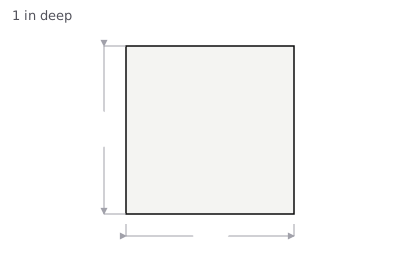
One inch, not three
The commonest paver mistake is a thick sand bed. Bedding sand levels;
it does not carry load. That job belongs to the compacted stone beneath
it, which the
gravel calculator
sizes. A deep sand bed ruts, and the ruts show as soon as anything heavy
crosses it.
Common mistakes
- Play sand under pavers. Rounded grains roll under load. You want angular concrete sand.
- Bedding deeper than an inch. It settles unevenly and shows.
- Taking a printed tonnage as fact. The published range is 11% wide.
- Forgetting the minimum load. On a small job it is most of the bill.
- Ordering sand for a base. That is compacted stone — the topsoil calculator covers soil, and sand is neither.
The rest of the job
Sand sits between the base and the pavers, so the
paver calculator counts what
goes on top and the
gravel calculator
sizes the compacted base underneath. If the area is not a plain
rectangle, the
square footage calculator
works it out and hands the figure over.
Common questions
How much sand do I need for pavers?
One inch of bedding sand under the pavers, which works out at about 0.31 cubic yards per 100 square feet. A 20 by 20 foot patio takes roughly 1.23 cubic yards. Resist going deeper — bedding sand is a levelling course, not a base, and a thick bed ruts and settles unevenly under traffic. The load is carried by the compacted stone underneath it.
How many tons of sand is a cubic yard?
Between 1.30 and 1.45 US tons, and this calculator will not narrow that for you without your supplier. Bedding sand is published as 2,600 to 2,900 pounds per cubic yard with no typical value in between, because it moves with grain size, moisture and how long it has been sitting in the rain. Enter the figure your yard quotes and you get a weight; leave it blank and you get volume only.
Why does this ask for the density instead of just knowing it?
Because nobody publishes one. Most sand calculators quietly pick a number from the middle of the range and present it as fact — usually 2,700 lb/yd³ — which is a guess wearing a decimal point. The honest answer is that the range is 11% wide and your supplier knows which end their product sits at. So the field is there, it is optional, and the ticket says plainly when no weight is being shown.
What kind of sand should I use?
For paver bedding, coarse concrete sand — not play sand and not mason sand. It is angular, it locks together under compaction, and it drains. Play sand is rounded and rolls under load; mason sand is too fine and holds water. For a sandbox, play sand is the right product precisely because it is rounded and washed.
Should I buy bagged or bulk?
Bagged for anything under about half a cubic yard, bulk above it — the same crossover every bulk material has. Open the pricing section and enter a yard price, a delivery charge and the minimum load and the ticket shows the delivered total, the yards you pay for and cannot use, and the real per-yard rate rather than the quoted one. On a small job the minimum load usually decides it.
Does sand settle?
Bedding sand is compacted as part of laying, so what you screed is roughly what you get and no settling allowance is applied. Fill sand in a trench is a different matter and will drop as it takes water — for that, order to the compacted depth and expect to top up.
Sources
- Bedding sand density
- 2600–2900 lb/yd3
No typical value was supplied, so none is stored.
Unit conversions are exact by definition and need no source.
How we choose and cite these figures