What most gravel calculators leave out
Every gravel calculator will multiply length by width by depth. This one
adds the step the others skip: you measure the finished, compacted layer,
but the quarry sells you loose material straight off the pile. Loose stone
occupies substantially more space than the same stone rolled and driven
on, so ordering the compacted figure leaves you short every single time.
That gap is a fifth to two fifths of the load.
It works for any gravel job — a driveway, a path, a shed base, a bed of
decorative stone — because the arithmetic is the same. What changes is
whether the layer gets compacted, and the driveway build is the case where
it does, twice, in two different materials.
Compacted cubic feet = length × width × (depth ÷ 12)
Loose cubic feet = compacted cubic feet × compaction factor
Cubic yards = loose cubic feet ÷ 27
Tons = cubic yards × density ÷ 2000
- compaction factor — 1.20 to 1.40, how much the material shrinks once rolled
- density — pounds per cubic yard, which varies by stone type and moisture
- 2,000 — pounds in a US short ton, the unit quarries invoice in
- depth — thickness of one layer, not the whole build-up
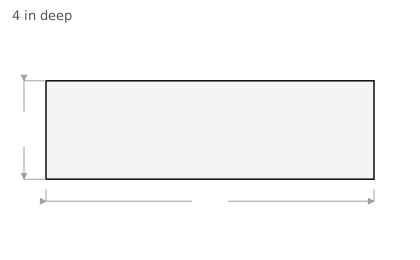
Worked example: a 40 by 10 foot drive, 4 inches deep
40 × 10 × (4 ÷ 12) = 133.33 compacted cubic feet
133.33 × 1.25 = 166.67 loose cubic feet
166.67 ÷ 27 = 6.17 cubic yards
6.17 × 2700 ÷ 2000 = 8.33 tons
Order 6.17 yards and you will lay roughly three and a quarter inches, not
four. The extra 1.5 yards is not waste — it is the air that gets driven
out of the material as it beds down.
Why density is given as a range
Crushed stone runs 2,600 to 2,900 pounds per cubic yard depending on the
rock and how wet it is. This calculates at the published typical of 2,700
and shows the spread rather than hiding it. Across a large order the ends
of that range differ by most of a ton, so ask your supplier for theirs.
Common mistakes
- Ordering the compacted volume. The single most common
error, and it under-orders by 20 to 40 percent.
- Treating tons and yards as interchangeable. A yard of
stone is roughly 1.35 tons. Quoting one and ordering the other is an
expensive slip in either direction.
- Calculating one thick layer. Anything over about four
inches goes down in lifts and each is compacted separately.
- Forgetting the sub-base. A drive that will carry cars
needs a coarse base under the decorative top. Calculate the layers
separately; they use different material.
When these numbers do not apply
- Pea gravel and sand. Rounded material barely locks
together and does not compact like angular crushed stone, so the
published compaction factor does not transfer.
- Soft or boggy ground. Stone pressed into mud vanishes.
Ground that pumps needs geotextile before any figure here means much.
- Recycled and crushed concrete. Densities differ from
quarried stone and vary batch to batch.
- Loose surface top-ups. If you are not rolling it, skip
the compaction factor entirely and order the plain volume.
Crushed stone per 100 ft² of driveway
Before compaction. A new driveway is normally a 4 in base plus a 2–3 in surface layer, and both compact by 15–20% once rolled.
Common questions
Why does it order more stone than the hole holds?
Because loose stone compacts. A four inch compacted base starts life as a deeper layer of loose material, and the ratio between the two is the compaction factor. It is published as a band of 1.2 to 1.4 rather than a single figure, because it depends on the stone and on how hard you compact it, and nobody publishes a typical value in between. The calculator orders at 1.4 so you will not come up short, and tells you what the bottom of the band would have been — up to seventeen percent less, which on a material sold by the ton is real money. If your supplier publishes a factor for their own material, enter it and the order drops.
How many tons of gravel do I need for a driveway?
A 40 by 10 foot drive at 4 inches works out around 8.3 tons of crushed stone once compaction is allowed for. Halve the depth and you roughly halve the tonnage.
What is a compaction factor?
The ratio between loose material and the same material once rolled. A factor of 1.25 means you must order 25 percent more than the finished layer measures, because that much air is driven out during compaction.
How deep should a gravel drive be?
Four inches is a common figure for a top layer over an existing base. A new drive carrying vehicles needs a deeper build-up in separate lifts, and the total depends on your ground conditions. Switch to the base-plus-surface option above and it works the two courses out separately, which is how you will actually order them.
Why does the calculator split base and surface?
Because they are two different products bought on two different tickets, and one combined tonnage is a number you cannot place with anyone. The base is angular crushed stone that locks together under compaction and carries the load; the surface is chosen for how it looks and how it feels underfoot, and it is laid loose. They also behave differently in the arithmetic: the base is ordered at its loose volume because it will be compacted, and the surface is not.
Why does it sometimes give yards instead of tons?
Because not every aggregate has a published typical density. Pea gravel, for instance, is published as a range with no typical value, so there is no honest weight to quote for it — and a total tonnage that quietly leaves a course out would be worse than no tonnage at all. When that happens the answer falls back to cubic yards, which every quarry will also quote in. Enter your supplier’s density and the weight comes back.
Should I order in tons or yards?
Whichever your supplier quotes in, and check which before you phone. This tool gives both from the same calculation so you can convert the quote rather than the load.
Why does the weight change with the weather?
Wet stone carries water, and water is heavy. Buying by the ton after rain means paying for moisture, which is one argument for buying by the yard where you have the choice.