Why block arithmetic is unusually clean
Concrete block is the one masonry unit where the numbers come out tidy,
and it is deliberate: nominal sizes already contain the mortar joint, so
the coursing works in whole inches. It is the one block calculator on this
site that needs no fudge factor at all.
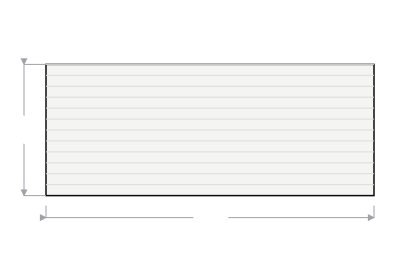
nominal face = 8 × 16 in = 0.888 ft²
blocks per ft² = 1 ÷ 0.888 = 1.125
blocks per course = ceil(wall length in inches ÷ 16)
courses = ceil(wall height in inches ÷ 8)
The block is smaller than its name
An 8 by 8 by 16 block actually measures 15 5/8 by 7 5/8 inches. The
missing three eighths in each direction is the joint, and that is why a
course of ten reaches exactly 160 inches. Build with the real dimension
and every tenth block puts you nearly four inches out.
Common mistakes
- Setting out from the actual block size. The nominal size is what courses.
- A wall height that does not divide by 8. It means a cut course, planned or not.
- Ordering corner units in the main count. They are a separate line at the supplier.
- Forgetting grout. Filled cores are a separate volume, not part of the block count.
Footings and facing
A block wall stands on a footing, and the
concrete calculator sizes that
pour with bag counts. If the block is a backing for brick veneer, the
brick calculator counts the
face — remember it gives one wythe, so the two are separate orders.
Blocks, courses and mortar by wall size
Standard 8 × 8 × 16 nominal block. Corner units are counted here as whole blocks; order them as a separate line.
Cinder block, concrete block, CMU
Three names, two products, and one of them is nearly extinct. A cinder
block used coal cinders as its aggregate: lighter, more porous, weaker,
and gone from most yards because nobody has cinders in quantity any more.
A concrete block — a concrete masonry unit, to give it its proper name —
uses sand and gravel or a lightweight mineral aggregate and is made to
ASTM C90, which is where every dimension on this page comes from.
In practice, if you are buying today you are buying CMU whatever the sign
above the pallet says, and this calculator is counting the right thing.
The one place the old distinction still bites is an existing wall: if you
are drilling, anchoring or building onto genuine cinder block, do not
assume it holds what a modern unit holds.
The rest of the build
Block is one course of a bigger job. The
brick calculator covers a
brick face or a brick wall on the same footing, the
retaining wall calculator
handles a wall holding ground back, and the
post hole calculator works
out the concrete around any post set into it. For an elevation that is
not one rectangle, the
square footage calculator
adds and subtracts areas and hands the total over.
Common questions
Is a cinder block the same as a concrete block?
Not historically, and the distinction still matters when you are buying. A cinder block was made with coal cinders as the aggregate, which made it lighter, more porous and considerably weaker. A concrete block — properly a concrete masonry unit — uses sand and gravel or a lightweight mineral aggregate and is manufactured to ASTM C90. What your merchant sells today is almost certainly the second, whatever the sign above the pallet says, because coal cinders stopped being a by-product anyone had in quantity. So this calculator counts blocks to the C90 dimensions, and if you genuinely have old cinder block in an existing wall, treat its strength as unknown rather than assuming it matches a modern unit.
How much grout does a filled core take?
About three tenths of a cubic foot per block for a standard eight inch unit with both cores filled — but that is worked out from the block rather than quoted from a table. Every grout figure circulating online disagrees with the next, because they are measuring different things and none of them says which. ASTM C90 publishes the two dimensions that settle it: a minimum inch and a quarter face shell and a minimum three quarter inch web. The core is what is left. Minimum shells and webs give the largest core a compliant block can have, so the order errs high — which is the right direction, because running short part way up a grouted core leaves a cold joint in it.
How many bars of rebar, and what size?
This counts the bars a spacing puts in; it does not choose the spacing or the size. Bar diameter, spacing and lap length are engineering and code questions that depend on the wall, the soil and the loads, and a number from this page would be read as an answer to them. Once your engineer or your local code has given you a spacing, enter it and the ticket gives the bar count and the linear feet before laps.
How many concrete blocks do I need per square foot?
Exactly 1.125 for standard 8 by 8 by 16 inch block. That number is unusually tidy because nominal block sizes already include the mortar joint: a nominal 8 by 16 inch face is 0.888 square feet, and one divided by 0.888 is 1.125. Nine blocks cover eight square feet.
Is a concrete block really 8x8x16?
No — the block itself is 15 5/8 by 7 5/8 inches, three eighths short in each direction. That missing three eighths is the mortar joint, and the nominal size is what the coursing is designed around. It is why ten blocks in a course reach exactly 160 inches rather than 156.
How many courses will my wall be?
The height in inches divided by 8, rounded up. An 8 foot wall is 96 inches, so twelve courses exactly — which is why 8 foot is such a common wall height in block. Heights that do not divide by 8 mean cutting a course or adjusting the joint, and the second is much harder than it sounds.
How much mortar does block need?
One 80 lb bag of Mason Mix lays up to 13 standard 8 by 8 by 16 inch blocks, which is the yield the manufacturer publishes and what this uses. Block still takes less mortar per square foot than brick, because there are far fewer joints in the same area — one block covers the ground of about six bricks — but the figure is substantially higher than the three bags of 70 lb per hundred blocks this page used to quote.
Do I need to fill the cores?
That depends on what the wall is doing, and it is a structural question rather than an arithmetic one. Many walls have only the cells containing rebar grouted; some are fully filled. This calculator counts blocks and mortar — if you are grouting cores, work the fill volume out separately and add it.
Does this include corner blocks?
They are counted as whole blocks, which is right for quantity but not for ordering. Corner units have one finished end and are a separate line at the supplier, so count your corners and split them out of this total when you place the order.
Sources
- Default waste allowance
- 5%
Nominal sizes already include the mortar joint, which is why a nominal 8 x 16 in face is 0.888 ft2 and one divided by that is exactly 1.125 blocks per square foot. Mortar is the published Mason Mix yield of 13 blocks per 80 lb bag, replacing an earlier 3 bags of 70 lb per hundred blocks that was roughly two and a half times short. Core volume for grout is computed from the published minimum face shell and web thicknesses rather than from a per-block grout figure. Minimum shells and webs give the largest possible core, so the grout order errs high — real units have thicker shells and tapered webs, and coming up short mid-lift means a cold joint in a grouted core. Block widths from 6 to 12 in carry their own face shell minimum, which is what makes core volume vary by so much more than the width alone suggests: a 12 in block holds nearly two and a half times the fill of a 6 in one, because the extra width goes into the core while the shells stay the same.
Unit conversions are exact by definition and need no source.
How we choose and cite these figures