Working out concrete for fence posts
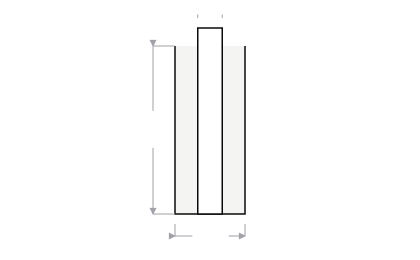
A post hole is a cylinder with a square timber standing in it. Concrete fills only what is left, so the honest figure is hole minus post, times the number of posts. Skipping that subtraction over-orders; forgetting the multiplier under-orders badly.
- diameter — the width of the auger or spade cut, in inches
- depth — how far down the hole goes, in inches
- width — the post's actual dimension: a nominal 4×4 measures 3.5 in, a 6×6 measures 5.5 in
- 12 — inches per foot, converting both to the same units
- π — the hole is round even though the post is square
Worked example: six posts, 10 in holes, 24 in deep
One hole alone needs 2 sacks, since 0.9207 divided by 0.60 rounds up. Six holes do not therefore need 12 — they need 10, because the leftover half of each sack goes into the next hole when you mix in batches. Buying by the hole rather than by the job is a quiet way to overspend by a fifth.
Why the allowance starts at zero here
A post hole loses almost nothing: small batch, tipped straight in, hole holds its shape. Watch the hole instead. Augers bell out in soft ground, and a spade-dug hole is rarely the neat cylinder the maths assumes.
Common mistakes
- Using the nominal post size. Entering 4 inches for a 4×4 overstates the post volume by a third and leaves you short.
- Rounding the bag count per hole, then multiplying. Two sacks a hole across six holes reads as 12 sacks, but the job takes 10.
- Measuring the hole at the top. An auger that wandered or a hole that crumbled is wider down the middle than it looks from above.
- Filling the hole to the surface. Most fence details stop the concrete short of grade so soil or gravel can cap it and shed water away from the timber.
When these numbers do not apply
- Belled or footed holes. A hole deliberately widened at the base to resist frost heave holds considerably more than a straight cylinder.
- Dry-set post mix. Some products are poured in dry and watered in place. Coverage is stated per hole on the sack and does not follow the yield used here.
- Gravel bases. Several inches of drainage stone under the post displaces concrete you would otherwise have bought.
Concrete per hole, around a 4×4 post (3.5 in actual)
| Hole | Concrete (ft³) | 80 lb bags | 60 lb bags | 50 lb bags |
|---|---|---|---|---|
| 8 in × 24 in | 0.53 | 1 | 2 | 2 |
| 8 in × 30 in | 0.66 | 2 | 2 | 2 |
| 10 in × 24 in | 0.92 | 2 | 3 | 3 |
| 10 in × 30 in | 1.15 | 2 | 3 | 4 |
| 10 in × 36 in | 1.38 | 3 | 4 | 4 |
| 12 in × 30 in | 1.75 | 3 | 4 | 5 |
| 12 in × 36 in | 2.10 | 4 | 5 | 6 |
| 12 in × 42 in | 2.45 | 5 | 6 | 7 |
One hole each, with the post's own volume already subtracted. Bag counts round up per hole; a run of holes usually needs fewer in total, because part-bags combine when you mix in batches.