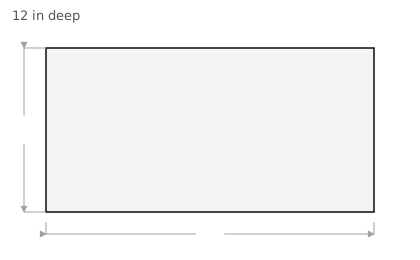
How much soil a raised bed takes
A raised bed is a box, so the arithmetic is the easy part. What catches
people out is that beds are deeper than they look from above, and that the
depth you fill is not the depth of the frame.
volume (ft³) = length × width × (fill depth / 12) × number of beds
volume (yd³) = volume (ft³) / 27
Worked example: the standard 4 × 8 bed
4 × 8 ft at 12 in fill = 32 ft³ = 1.19 yd³
in 2 ft³ bags = 16 bags
two beds = 64 ft³ = 2.37 yd³
Two beds is where bagged soil stops making sense. Sixteen bags is a car
boot; thirty-two is a pallet, and a pallet costs more than a bulk yard
delivered almost everywhere.
Fill depth is not frame height
Fill two to three inches short of the rim. Soil level with the top washes
over the edge in the first downpour, and you have no room to mulch without
burying the base of your plants. A twelve inch frame is a nine or ten inch
fill, and ordering for the frame height buys soil that ends up on the path.
Common mistakes
- Ordering for the frame height. You fill short of the rim, deliberately.
- Buying bags past one cubic yard. That is only two standard beds.
- Filling deep beds entirely with growing mix. Below eighteen inches it is structure, not soil.
- Filling level and expecting it to stay. Fresh soil settles in its first season; top up rather than over-fill.
- Using bare topsoil. Screened topsoil alone compacts in a bed. It needs opening up.
Filling and finishing
Beds deeper than about eighteen inches do not need growing mix all the way
down, and bulk screened topsoil is the usual filler — price it with the
topsoil calculator. Once
planted, the mulch calculator
works out the covering that keeps the moisture in.
Soil for one bed, by size and fill depth
Fill depth, not frame height — beds are filled two to three inches short of the rim. A 2 ft³ bag is the common bagged size, so divide the cubic feet by two for a bag count.
The rest of the bed
Soil goes into something. The
deck board calculator
works out the boards for the sides, the
board foot calculator
prices timber the way a yard quotes it, and the
mulch calculator covers what
goes on top once it is planted. Filling a border rather than a box? The
topsoil calculator takes an
area and a depth, and the
square footage calculator
handles a bed that is not rectangular.
Common questions
What should I fill a raised bed with?
Not straight topsoil, and not straight compost either. Iowa State University Extension recommends equal parts topsoil, organic matter — well-rotted manure, compost or peat — and coarse sand, or roughly seventy percent topsoil to thirty percent compost if you would rather buy two things than three. Pick either above and the ticket splits your total into the yardage of each, because that is how the yard sells it and doing the division in your head at the counter is how people end up with the wrong load.
Is bulk actually cheaper than bags?
Not always, and the two numbers that decide it are the two nobody puts in a calculator. A yard charging 45 a yard sounds like it beats bags twice over — until you add the three yard minimum and the 75 delivery charge, at which point one yard of mulch costs 210 rather than 84, and the bags win. Enter the delivery charge and the minimum load alongside the per-yard rate and this works out what the load actually bills at, tells you how many yards you are paying for and cannot use, and gives you the real delivered price per yard rather than the one on the price list.
How much soil does a 4x8 raised bed need?
At the usual 12 inch fill depth, a 4 by 8 foot bed takes 32 cubic feet — just under 1.2 cubic yards, or about sixteen 2 cubic foot bags. That figure surprises people because beds look small from above and are deceptively deep, which is why buying by the bag for anything bigger than a single bed gets expensive fast.
Should I fill to the top of the frame?
No. Fill to two or three inches below the rim. Soil above the rim washes over the edge in the first heavy rain and you lose it onto the path, and you need the freeboard to mulch without burying the crowns of your plants. The fill depth is not the frame height, which is why this calculator asks for them as different things.
Do I need to fill the whole depth with good soil?
Not below about eighteen inches. Most vegetable roots work the top foot, so a deep bed can take cheaper bulk fill or coarse organic matter in the bottom third with a good growing mix above. Below that the material is doing structural work, not growing work.
What mix should go in a vegetable bed?
A common starting point is roughly half screened topsoil, a third compost and the rest something that keeps it open — coarse sand, perlite or bark fines. This calculator gives you the total volume; how you split it is a horticultural decision that depends on your climate and what you are growing, and it is not one arithmetic should make for you.
Why do my beds sink after the first year?
Because fresh soil is full of air and organic matter, and both reduce. A bed filled level in spring commonly drops an inch or two by the following spring, and beds with a lot of compost drop more. Top up annually rather than over-filling at the start, which just washes the surplus onto the path.
Is bagged or bulk soil cheaper?
Bulk, once you pass roughly a cubic yard — which is only two 4 by 8 beds at a 12 inch fill. Below that the delivery charge usually outweighs the saving. Work out your total volume first, then price both ways including delivery; the crossover point moves a lot depending on how far you are from the supplier.
Sources
- Screened topsoil density
- 1900–2300 lb/yd3
Highly moisture-dependent. The range must always be surfaced to the user. No typical value was supplied. Settling is real and is not a published number. The implementation plan gives +15% and this page once carried a warning saying 'roughly a tenth'; neither is sourced, and the extension services that discuss it describe it qualitatively and recommend annual topdressing rather than over-filling at the start. So no settling allowance is applied by default. The calculators offer it as an allowance you enter yourself, in the same way waste is entered, and say plainly that no figure is published. Bag volumes are what the bag says and nothing is derived from them here: how many bags make a cubic yard is 27 divided by the bag, computed where it is needed rather than stored beside its own inputs. Bagged soil is dear per yard and the calculator shows both, because a 4 x 8 ft bed is a bag job and three of them is a delivery.
Unit conversions are exact by definition and need no source.
How we choose and cite these figures