How a French drain is sized
A French drain is a trench filled with clean stone, usually with a
perforated pipe at the bottom, that gives water an easier path than the
soil around it. Sizing one is two questions: how big is the trench, and
how much of it is not pipe.
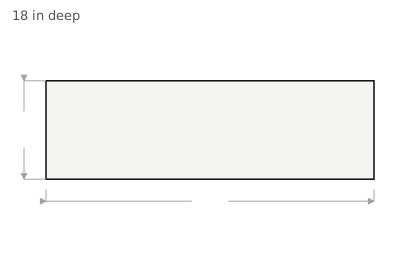
trench = length × width × depth
pipe = pi × (pipe diameter / 2)² × length
stone = trench − pipe
The subtraction is the part worth doing properly. A 4 inch pipe running
the length of a 12 inch wide trench displaces roughly a tenth of it. On a
short run that is a bag or two; on a 60 foot run it is close to a cubic
yard of stone ordered, delivered and never used.
What the fabric has to cover
Filter fabric wraps the stone, it does not line the floor. That means its
width has to cover the trench bottom, both sides, and enough overlap to
fold across the top — so for an 18 inch deep, 12 inch wide trench you need
roughly four feet of width, not one. The calculator reports the width you
actually need rather than the trench width.
Common mistakes
- Pea gravel instead of angular stone. Rounded stone
packs together and closes its own voids. Use washed, angular stone.
- No fabric, or fabric only under the stone. Silt
arrives from the sides and the top as well as the bottom.
- Holes facing up. Water enters a perforated pipe from
below; holes down means it drains sooner.
- No outlet. A drain has to end somewhere that can take
the water legally. A trench with a blind end is a soakaway, and it needs
sizing as one.
- Ordering stone by the trench volume. The pipe is in
there too.
When this does not apply
- Structural or foundation drainage. A drain that
protects a building is engineering, not landscaping. Get it designed.
- Septic and leach fields. Those are sized by percolation
test and regulated separately.
- Heavy clay with nowhere to go. A French drain moves
water, it does not absorb it. In clay with no outlet you need a sump.
Stone, and where the water goes
The stone in a drain is the same crushed aggregate a driveway base uses,
and the gravel
calculator prices it by the ton if you are ordering both together.
Once the trench is backfilled and capped, the
topsoil calculator works
out what it takes to bring the surface back to grade.
Stone per 100 ft of trench
The pipe column is the one to order from if you are laying pipe — over 100 ft a 4 in pipe displaces close to a cubic yard of stone you would otherwise pay to have delivered.
The rest of the groundwork
A drain is usually part of a larger dig. The
gravel driveway calculator
works out stone by the ton the way a quarry sells it, the
topsoil calculator covers
what goes back on top, and the
retaining wall calculator
handles the wall a drain often runs behind. For the trench itself the
square footage calculator
takes an awkward run and gives you an area, and the
post hole calculator covers
anything set in concrete alongside it.
Common questions
What do I need at the outlet end?
More than most lists include. Pick your outlet above — daylight, a dry well, a catch basin or a storm connection — and the parts go on the ticket: a grate, ten feet of solid pipe so the last stretch cannot silt back into the trench, a basin if you are collecting surface water too. A dry well has to be sized for your soil and rainfall by a percolation test rather than by this page, and a storm connection usually needs your authority’s permission and an inspection. What the calculator does is stop you arriving at the end of the trench with nothing to finish it.
How much fall does the drain need?
At least one percent — about an inch in every eight feet — from the head of the run to the outlet, which is what the University of Georgia’s stormwater guidance recommends and what most drainage practice follows. This page used to state that and then admit it did not check. Now it does: measure how much lower the outlet end is, enter it, and the ticket tells you the slope you actually have, the drop this run needs, and how far short you are if you are short. A forty foot run needs five inches of drop. Finding out you have three after the trench is backfilled is the expensive way to learn it.
How deep should a French drain be?
Deep enough that its base sits below whatever you are trying to keep dry. Around a foundation that means below the footing top; across a lawn it usually means 18 to 24 inches. The depth that matters is the outlet end — the whole trench has to fall towards it, so a drain that starts deep and ends deeper than its outlet will simply fill up and stay full.
Does the pipe really change how much stone I need?
More than people expect. A 4 inch pipe in a 12 inch trench occupies about a tenth of the volume, and over a 60 foot run that is close to a cubic yard of stone you would otherwise have ordered and paid to have delivered. This calculator subtracts the pipe from the trench rather than treating the trench as solid fill.
What size stone should I use?
Clean, angular, washed stone between 3/4 and 1.5 inches. The two words doing the work are clean and angular: washed stone has no fines to clog the voids, and angular stone locks together instead of rolling, so the trench keeps its shape. Pea gravel is the common mistake — it is rounded and it packs, which is the opposite of what a drain needs.
Do I need filter fabric, and where does it go?
Yes, and it wraps the stone rather than lining the trench floor. Soil migrates into the voids between stones from every direction, and once those voids silt up the drain stops draining — usually within a few seasons. Lay the fabric into the trench, fill with stone, then fold the surplus over the top before you cap it.
Which way up do the holes on the pipe face?
Down. It is counter-intuitive and it is the most argued-about detail in drainage. Water rises into the pipe from the water table below, and holes facing down let the pipe start draining before the water level has risen through the whole stone bed. Holes up means the water must fill the trench first.
How much fall does a French drain need?
At least one percent — an inch of drop for every eight feet of run. Less than that and water sits in the pipe; much more and the water outruns the stone and carries fines with it. This tool sizes the trench and its materials, it does not check your fall, so set a string line and confirm the drop before you dig.
Sources
- Crushed stone / gravel density
- 2600–2900 lb/yd3
- Washington State DOT Design Manual M 22-01.23, Exhibit 620-1, Unit Dry Weight — Gravel Base and Surfacing: crushed surfacing top course 2,850 lb/cy and base course 2,950 lb/cy at truck measure, gravel base 3,400 to 3,800 lb/cy. Weights are dry and require correction for water content
- SOURCE REQUIRED — your supplier's own published density. These are dry road-specification weights; a landscaping product of the same name will differ, and moisture moves the figure more than grading does
Awaiting verification against the published data sheet
- University of Georgia Urban Water Management, Green Stormwater Infrastructure demonstration site — french drain slope and grading: a minimum slope of 1 percent, approximately 1/8 inch per foot, is recommended
Density varies by stone type and moisture content and must be surfaced to the user as a range. Compaction factor applies to loose volume for base course. No waste factor was supplied for this material. The stored band is anchored on WSDOT's Exhibit 620-1, the best published figures available: crushed surfacing runs 2,850 to 2,950 lb per cubic yard dry at truck measure. Two caveats travel with them and are surfaced to the user rather than buried. They are DRY weights — WSDOT says plainly that corrections are required for water content, and wet stone off an open stockpile weighs materially more. And they are road specification gradings; a landscaping supplier selling under the same name is not selling the same material. A supplier figure always beats these, which is why the calculator takes one.
Unit conversions are exact by definition and need no source.
How we choose and cite these figures