Two things decide it, and most calculators ask for neither
Species. Shagbark hickory is more than twice the density
of northern white cedar. A rack of one is not a rack of the other, and an
average across "wood" is useful for nothing.
Moisture. Water is heavy, and green timber is full of
it. The same 2 × 6 that weighs 15.4 lb
seasoned weighs 19.3 lb green —
26% more, for the identical piece of wood.
An 8 ft 2 × 6, by species
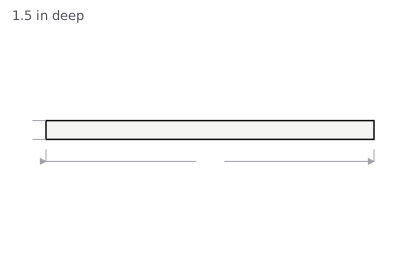
Actual size 1.5 × 5.5 in. Densities from USDA Wood Handbook Table 5-3a, via this calculator.
Actual size, not nominal
Enter what the board measures, not what it is called. A 2 × 6 is
1.5 × 5.5 in and weighs what that measures — 23% less than the name
implies. This is the exact opposite of the
board foot calculator,
which works in nominal sizes because nominal is what the yard bills.
You are charged for the name and you carry the measurement.
Where the numbers come from
The USDA Forest Products Laboratory Wood Handbook publishes specific
gravity by species on two volume bases: ovendry mass over green volume,
and ovendry mass over volume at 12% moisture. Both matter, because wood
shrinks as it dries — so the same board gets denser and lighter at the
same time.
At 12%, the Handbook publishes G directly:
density = G12 × 62.43 × 1.12
At any other moisture content:
Gx = Gb ÷ (1 − 0.265 · a · Gb), a = (30 − x)/30
density = Gx × 62.43 × (1 + x/100)
Checked against the Handbook's own white ash example:
0.55 basic → 42.1 lb/ft³ against their 42.2.
Above 30% moisture the wood has stopped shrinking, so more water adds
weight without changing the volume. That is a real physical bound, not a
simplification, and the calculator respects it.
Common mistakes
- Using nominal dimensions. 23% too heavy.
- Assuming seasoned. Green stock can be half again as heavy.
- One density for all wood. The range across species is more than two to one.
- Loading to the limit. Specific gravity varies about 10% inside a species.
The rest of the job
The board foot calculator
handles what you are billed for, in nominal sizes, and converts between
square feet and board feet. Scaling a log rather than a board? The
log board foot calculator
does Doyle, Scribner and International side by side. For sheet goods the
plywood calculator counts
sheets and the cut list optimiser
lays them out.
Common questions
How much does a 2 by 6 weigh?
About 15.4 pounds for an 8 foot Douglas-fir at 12% moisture — but the species and the moisture both move it a long way. The same stick in eastern white pine is lighter, in hickory nearly twice as heavy, and green off the saw it is 26% heavier again. There is no single answer to "what does a 2 by 6 weigh", which is why this asks for both.
Do I enter the nominal size or the actual one?
The actual one. A 2 by 6 measures 1.5 by 5.5 inches, and it weighs what that measures — 23% less than the name suggests. This is the opposite of the board foot calculator, which uses nominal sizes because that is what you are billed on. You are charged for nominal and you carry actual.
Why does moisture content matter so much?
Because water is heavy and green wood is full of it. Timber straight off a saw can be 50% moisture or more — meaning half its dry weight again in water — and it dries down to around 12% indoors. On the example above that is a 26% swing on the same piece of wood. Any weight figure quoted without a moisture content attached is not usable for anything.
Where do the densities come from?
The USDA Forest Products Laboratory Wood Handbook, Table 5-3a, which publishes specific gravity by species on two volume bases. At 12% moisture the Handbook publishes the figure directly and this uses it directly. At any other moisture content the basic specific gravity is carried across using the Handbook's own Equation 4-11 and turned into a density by Equation 4-12. The whole chain was checked against the Handbook's worked example for white ash and reproduces it.
How accurate is it?
Treat it as the middle of a spread rather than a figure to load a trailer to the limit against. Specific gravity varies about 10% within a species — the Wood Handbook says so — because of the ratio of earlywood to latewood, heartwood to sapwood, and where the tree grew. Two boards off the same rack can differ noticeably.
Why is one species missing?
Western white pine is deliberately absent. Table 5-3a lists its specific gravity at 12% moisture as lower than its green figure, which cannot be right for a material that shrinks as it dries. Rather than ship a number that looks wrong, the species is left out and this note says why.
Sources
- USDA Forest Products Laboratory, Wood Handbook (FPL-GTR-190), Table 5-3a — specific gravity by species, ovendry mass with volume when green (basic) and at 12% moisture content. Footnote: "for green wood, use specific gravity based on ovendry weight and green volume; for dry wood, use specific gravity based on ovendry weight and volume at 12% moisture content"
- USDA Forest Products Laboratory, Wood Handbook (FPL-GTR-190), Chapter 4, Methods for Calculating Density — density at moisture content x is Gx times the density of water times (1 + x/100), Equation 4-12, with water at 62.43 lb/ft3; Gx from basic specific gravity by Equation 4-11 using a fibre saturation point of 30% and the Stamm shrinkage coefficient 0.265
Two specific gravities per species because the Handbook publishes two, and they are not interchangeable: the basic one is ovendry mass over GREEN volume, the other is ovendry mass over volume at 12% moisture content. Both have ovendry mass on top; only the volume basis differs, and wood shrinks as it dries, so G12 is always the larger of the two. Density at 12% is taken from G12 directly rather than derived, because the Handbook publishes it. At any other moisture content Gx is computed from the basic figure by Equation 4-11 and turned into a density by Equation 4-12. The whole chain was checked against the Handbook's own worked example for white ash: basic 0.55 gives G12 0.605 and a density of 678 kg/m3 (42.2 lb/ft3), and this reproduces it. Western white pine is deliberately absent: Table 5-3a lists its 12% specific gravity BELOW its green one, which cannot be right for a material that shrinks as it dries, so rather than ship a figure that looks wrong the species is left out.
Unit conversions are exact by definition and need no source.
How we choose and cite these figures