How firewood is measured
Firewood is sold by volume, and there is exactly one volume that is
defined: the cord. Everything else you will be quoted is a local term for
a stack of unspecified depth, which is why the same word can mean three
different quantities in three neighbouring counties.
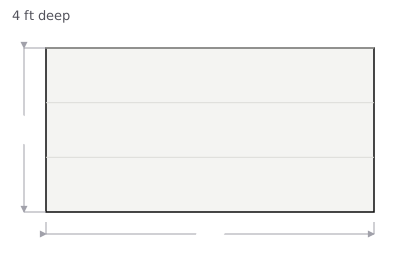
full cord = 128 ft³ = 4 ft × 4 ft × 8 ft, stacked
cords = (stack length × stack height × log length) / 128
Why a face cord is not a cord
A face cord is four feet high and eight feet long — the same face as a
full cord — but only one log deep. So its volume depends entirely on how
the seller cut the wood, and nothing about the name tells you which.
16 in logs: 4 × 8 × 1.33 ft = 42.7 ft³ = 0.33 cord
24 in logs: 4 × 8 × 2.00 ft = 64.0 ft³ = 0.50 cord
Same stack, same face, half again as much wood — purely because the pieces
are longer. If a price is quoted per cord and what arrives is a face cord
of sixteen inch logs, the real rate is three times what was agreed.
How to measure a delivery properly
- Stack it first. A tipped heap cannot be measured and cannot be argued about.
- Measure the stack length and height as it stands, in feet.
- Measure a few pieces for the log length — that is the depth of the stack, and it varies more than sellers admit.
- Do it before burning any. Once the stack is broken the evidence is gone.
What this calculator will not tell you
- Heat output by species. BTU-per-cord tables vary by
source and moisture content, and this site does not publish a physical
figure it cannot cite. Your state or university forestry extension
publishes one for local species.
- Whether the wood is seasoned. Moisture matters more
than species for how a fire behaves. Use a moisture meter; under twenty
percent is the usual target.
- How much you will burn in a season. That depends on
your climate, your appliance and your house, not on arithmetic.
Measuring timber other ways
Firewood is sold by stacked volume; sawn timber is sold by board foot,
which is a different measure entirely — the
board foot calculator
covers that. If you are milling your own and want to plan what comes out
of each log, the cut list
optimizer plans the cuts.
What a 4 × 8 ft face cord really is, by log length
A full cord is 128 ft³ however it is stacked. The last column is how long a 4 ft high stack has to run to make one at that log length — the number to check a delivery against.
Other things sold by the yard
Firewood is one of several materials bought by volume from someone with a
truck, where the honest question is whether you got what you paid for.
The mulch calculator and the
topsoil calculator both
compare bags against a bulk load, and the
gravel driveway calculator
works in tons as well as yards because that is how quarries quote.
Stacking against a wall you are also building? The
retaining wall calculator
sizes the blocks and the base.
Common questions
How big is a full cord of firewood?
A full cord is 128 cubic feet of stacked wood — the volume of a stack four feet high, four feet deep and eight feet long. The word stacked is doing real work there: the measurement assumes the pieces are laid tightly in rows, not thrown in a heap, and loose-tipped wood occupies far more space than the same cord stacked.
What is a face cord, and is it the same thing?
No, and this is where most people are overcharged. A face cord or rick is a stack four feet high and eight feet long, but only as deep as the logs are long. With sixteen inch logs that is 42.7 cubic feet — a third of a cord. Buy a "cord" at a cord price and receive a face cord and you have paid three times the rate.
How do I check what I was actually delivered?
Stack it, then measure it. Length along the stack, height off the ground, and the log length as the depth. Those three multiplied give cubic feet, and dividing by 128 gives cords. Do it before you burn any, and do it with the wood stacked rather than piled — a photograph of a heap proves nothing.
Is a "rick" the same as a face cord?
Usually, but not reliably, and that is the problem. Rick, face cord, rack and stove cord are all regional terms for a four by eight foot stack of unspecified depth. None of them is a defined volume, so the only safe question to ask a seller is how long the pieces are cut and how many feet of stack you are getting.
Why does my stack measure less than a cord when I paid for one?
Either the pieces are shorter than you assumed, or the stack is not as tight as the price assumed. Both are common and neither is necessarily dishonest — split wood stacks with air gaps, and a loosely stacked cord can measure ten percent short. If it is more than that, you were sold a face cord.
Does the species change how much I need?
Enormously, but this calculator will not tell you that, because it will not print a heat figure it cannot source. Dense hardwoods like oak and hickory carry roughly twice the heat per cord of softwoods like pine. Get the numbers from your state or university forestry extension rather than from a firewood seller.
Sources
A cord is a legal measure, not a rule of thumb: NIST Handbook 130 defines it as 128 cubic feet ranked and well stowed, and a seller may not lawfully sell by the truckload, face cord, rack or pile. Heat values are USU Extension's Table 1 and vary by nearly three to one across the list — osage-orange at 32.9 million BTU per cord against eastern redcedar at 13.0 — which is why a cord of one species is not interchangeable with a cord of another. The source does not state the moisture content its dry weights assume, so no seasoning adjustment is derived from them.
Unit conversions are exact by definition and need no source.
How we choose and cite these figures