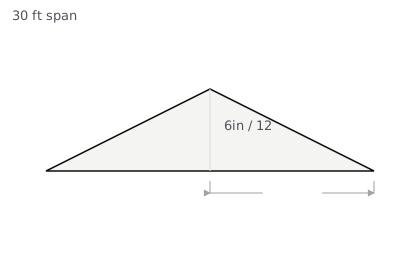
Why a roof is bigger than the house under it
You measure a roof on the ground and you cover it on the slope, and those are two different areas. The gap between them is the single largest source of short orders in roofing, and it is the first thing any roofing calculator has to get right before the bundle count means anything.
Pitch multipliers
Worked example: 1,500 ft² at 6/12
Order for the footprint instead and you buy 50 bundles for a roof that needs 56 — six bundles short, discovered on the last plane, in a colour batch that may no longer match.
Common mistakes
- Ordering the footprint. A 6/12 roof is twelve percent bigger than the ground it covers.
- Ten percent waste on a hip roof. Cut waste on hips and valleys runs closer to fifteen.
- Forgetting the accessories. Starter, ridge cap, underlayment and drip edge are separate.
- Ordering exactly. Colour batches vary; a spare bundle now beats a mismatched one later.
When this does not apply
- Anything but standard architectural shingles. Three-tab, metal, tile and slate all cover differently.
- Roofs with several different pitches. Work out each plane separately and add them.
- Structural questions. Whether your deck can carry a second layer is not an arithmetic question.
Under the shingles
Shingles need a sound deck under them, and a re-roof often means replacing sheathing — the plywood calculator counts sheets across every size your yard stocks. If your roof is not a simple rectangle in plan, take the footprint from the square footage calculator and bring it back here.
Pitch multiplier and bundles for a 1,500 ft² footprint
| Pitch | Multiplier | Roof area (ft²) | Squares | Bundles at 10% |
|---|---|---|---|---|
| 3/12 | 1.031 | 1546 | 15.5 | 52 |
| 4/12 | 1.054 | 1581 | 15.8 | 53 |
| 5/12 | 1.083 | 1625 | 16.3 | 54 |
| 6/12 | 1.118 | 1677 | 16.8 | 56 |
| 7/12 | 1.158 | 1737 | 17.4 | 58 |
| 8/12 | 1.202 | 1803 | 18.0 | 60 |
| 9/12 | 1.250 | 1875 | 18.8 | 62 |
| 10/12 | 1.302 | 1953 | 19.5 | 65 |
| 12/12 | 1.414 | 2121 | 21.2 | 71 |
The multiplier is the whole point: the same building takes 50 bundles at 3/12 and 71 at 12/12. Measure the footprint on the ground, then apply your pitch.
The rest of the roof
Field shingles are the biggest line on the order and nowhere near all of it. Underlayment and nails follow the roof area, so the calculator counts them whatever you enter. Starter, ridge cap and drip edge follow lengths it cannot know — open Add the rest of the roof and give it your eaves, rakes and ridges, and they appear on the list.
A worked roof: 1,500 ft² footprint at 6/12, 100 ft of eaves, 60 ft of rakes, 45 ft of ridge
| Item | Buy |
|---|---|
| Bundle | 56 |
| Starter strip bundle | 1 |
| Hip and ridge bundle | 2 |
| Underlayment roll | 2 |
| 10 ft drip edge | 16 |
| 5 lb box of nails | 4 |
| 1 lb box of nails | 3 |
Underlayment is figured net of its published 4 in lap, so a roll covers 917 ft² rather than the 1,000 printed on it. Valley metal, ice and water shield and pipe boots are not counted — what each roof needs depends on your climate zone and local code.
What goes on under it
Below the shingles is a deck. The plywood calculator counts sheathing sheets, the square footage calculator takes a roof that is not one plain rectangle and gives you a footprint to bring back here, and the board foot calculator prices rafters and framing the way a yard quotes them. Re-roofing over a deck you are also building? The deck board calculator covers the boards, and the deck stain calculator finishes them.