Stucco calculator

Base coat and finish coat counted separately, from the published coverage at the thickness you are applying.

System
Units

Three coat puts this on twice. What your wall actually needs comes from ASTM C926 for your lath and substrate.

Only the thicknesses the manufacturer publishes a coverage for.

Waste

Why 10%?

Stucco is mixed in batches and what is left in the hawk at the end of one does not go into the next. Five per cent is a starting point, not a published figure.

Material estimate

Enter the wall size to see the bags, coat by coat.

    Coats, not thickness

    Stucco is not one material applied once. A traditional three coat system puts the same base coat on twice — the scratch and the brown — and then a completely different product over it. Treating the job as one thickness of one material, which is what a single "coverage per bag" figure forces you to do, under-orders the base by half and mis-prices the finish entirely.

    base bags = area × coats ÷ coverage at that thickness finish bags = area ÷ finish coverage 500 ft² of wall Three coat, 3/8 in 50 base + 8 finish = 58 Two coat, 3/8 in 25 base + 8 finish = 33 Finish only 8 bags The base doubling is the whole difference.

    A bag of base is not a bag of finish

    One 80 lb bag of base coat covers 20 to 24 square feet at 3/8 inch. One 80 lb bag of finish coat covers about 70 at 1/8 inch. Same weight, same manufacturer, three times the ground — because one is building thickness over lath and the other is a decorative skin. Averaging them into a single figure, which is what a "stucco calculator" that asks only for an area has to do, produces a number that is wrong for both.

    Published coverage per bag

    Published coverage per bag
    ProductRoleThicknessCoverageBag
    Scratch and Brown Base Coat (No. 1139), 80 lbBase3/8 in20–24 ft²80 lb
    Scratch and Brown Base Coat (No. 1139), 80 lbBase1/2 in15–18 ft²80 lb
    Scratch and Brown Base Coat (No. 1139), 80 lbBase3/4 in10–12 ft²80 lb
    Finish Coat (No. 1201), 80 lbFinish1/8 in70 ft²80 lb
    Color & Texture Finish Coat, 80 lbFinish1/16 in100–103 ft²80 lb
    Color & Texture Finish Coat, 80 lbFinish1/4 in24–27 ft²80 lb

    QUIKRETE data sheets for Scratch and Brown Base Coat (No. 1139), Finish Coat (No. 1201) and the Color & Texture Finish Coat. All coverages are published as approximate and vary with thickness, waste and texture.

    Which system you have is not a preference

    Three coat over metal lath is the traditional assembly on framed walls. Two coat is normal over solid masonry or concrete, where there is no lath to embed a scratch coat into. Which one applies to your wall is set by ASTM C926 and by what you are rendering onto — and it roughly doubles or halves the base coat order, so it is the first thing the calculator asks.

    Texture eats material

    QUIKRETE's own sheet says coverage varies with texture, and the Color and Texture Finish Coat is published at two thicknesses for exactly that reason: 100 to 103 square feet a bag at 1/16 inch, and 24 to 27 at 1/4. A heavy dash finish is not a 1/16 inch finish no matter what the smooth areas measure. Pick the thickness that matches what you are actually applying rather than the thinnest one on the list.

    What is not in this number

    • Lath, paper and beads. Weather-resistive barrier, metal lath, weep screed, casing and corner bead, control joints and fasteners are separate orders and often the bigger half of a re-render.
    • Openings. Deduct them from the area before you enter it — but not the returns, because reveals are stucco too.
    • Curing. Portland cement plaster needs moist curing between coats, and skipping it is how a wall crazes. It costs time, not bags.
    • Colour. Integral colour is added to the mix water and does not change the coverage; a painted finish is a separate job entirely.

    The rest of the wall

    Where the stucco is going over masonry rather than lath, the concrete block calculator and the brick calculator count what is underneath it, and the block fill calculator covers grouting the cores before anything goes on the face. For a framed wall, the wall framing calculator counts the studs and plates behind the lath. If the finish you want is a coating rather than a render, the deck stain calculator works the same way this page does — from published coverage per gallon rather than a rule of thumb.
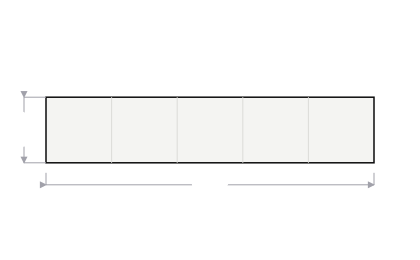
    Elevation of a 50 by 10 foot stucco wall, the area every coat has to cover in turn.
    Drawn to scale.

    Common questions

    How many bags of stucco do I need?

    It depends on how many coats, and that is the question most calculators skip. Five hundred square feet in a three coat system at 3/8 inch a coat takes 50 bags of base coat and 8 of finish — 58 in total. The same wall in a two coat system takes 25 plus 8. The difference is not the finish; it is that a three coat job applies the base twice.

    How much does a bag of stucco cover?

    An 80 lb bag of QUIKRETE Scratch and Brown Base Coat covers 20 to 24 square feet at 3/8 inch, 15 to 18 at 1/2 inch and 10 to 12 at 3/4 inch. An 80 lb bag of Finish Coat covers about 70 square feet at 1/8 inch. Those are wildly different numbers because they are different materials doing different jobs, and adding them into one "stucco covers X" figure — as most pages do — makes both wrong.

    What is the difference between a two coat and a three coat system?

    Three coat is the traditional build-up over metal lath: a scratch coat, a brown coat and a finish coat, with the first two being the same base material. Two coat puts the base on once, and it is normal over solid masonry or concrete where there is no lath to embed. What your wall needs is set by ASTM C926 for your substrate, not by preference — and it changes the material order by roughly a factor of two, which is why it is the first thing this tool asks.

    How thick should each coat be?

    The base coat products here are published at a minimum 3/8 inch, and the calculator only offers the thicknesses the manufacturer published a coverage for. The actual thicknesses your assembly needs come from ASTM C926 and vary with the substrate, the lath and whether the wall is vertical or a soffit. Take them off your specification. Guessing thicker costs money by the pallet; guessing thinner fails inspection.

    Do I need to add for waste?

    Yes, and the published figures already say they are approximate — "all coverages are approximate and vary with thickness, waste, etc." Stucco is mixed in batches, and what is left in the hawk and the mixer at the end of a batch does not go into the next one. A five per cent allowance is a starting point rather than a published number, which is why it is a field you can change rather than something baked into the answer.

    Does the finish texture change how much I need?

    Materially. QUIKRETE's own data sheet says coverage "will vary with texture" — a heavy dash or a coarse sand finish carries far more material than a smooth float, at the same nominal thickness. The Color and Texture Finish Coat is published at two thicknesses precisely because of this: 100 to 103 square feet a bag at 1/16 inch and 24 to 27 at 1/4. Pick the thickness that matches the texture you are actually applying.

    What about the lath, the paper and the beads?

    Not counted here, and on a re-render they are usually most of the material list. Weather-resistive barrier, metal lath, weep screed, casing bead, corner bead, control joints and the fasteners for all of it are separate orders governed by your assembly. This tool answers the question it can answer exactly — how many bags of mixed material go on the wall — and says plainly what it is leaving out.

    Should I deduct windows and doors?

    Deduct the openings before you enter the area, but do not deduct the returns. The reveals around a window are stucco too, and on a wall with a lot of openings the returns can put back a fair share of what the openings took out. If you are working from a rough wall area with no deductions, you are carrying the openings as waste — which on a wall that is mostly glass is a lot of bags.

    Sources

    Coverage is stored per applied thickness because that is how it is published; there is no density here and no attempt to derive one, since a bag's coverage depends on how much water it is mixed with and how it is worked. The two finish products are kept separate rather than merged: they cover very differently at the same thickness, and a blended figure would be a number neither manufacturer prints. Coat thicknesses in a real assembly are set by ASTM C926 for the substrate and lath you have, which is why the tool asks for the thickness rather than assuming a three coat build-up.

    Unit conversions are exact by definition and need no source.

    How we choose and cite these figures

    By Team MaterialMath. Published . How these figures are sourced and checked.