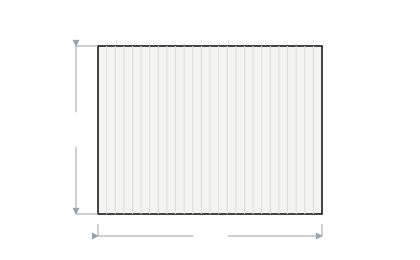
How deck boards are counted
Decking is bought by the board, not by the square foot, and the number of
boards comes from the number of rows. The row count is where the gap does
its work — and it is the step a deck calculator that starts from square
footage cannot take.
rows = ceil( deck width (in) ÷ (board width + gap) )
linear feet = rows × deck length × (1 + waste)
boards = rows ÷ runs each board covers
Worked example: a 12 × 16 ft deck
width 12 ft = 144 in
board 5.5 in + 0.25 in gap = 5.75 in per row
rows = ceil(144 ÷ 5.75) = 26
16 ft boards across a 16 ft deck = 1 row each = 26 boards
Ignore the gap and 144 ÷ 5.5 gives 26.2, which rounds to 27 — one board
more than the deck can take. That single row is the most common ordering
error on a deck, and it is entirely caused by leaving the gap out.
Common mistakes
- Using the nominal width. A 5/4 × 6 is 5.5 in, not 6.
- Leaving the gap out of the row count. It is worth a whole row on a typical deck.
- Ordering linear feet instead of boards. You buy fixed lengths; a board that is 4 ft short of a run is not usable on that run.
- Laying diagonal on 16 in joists. A 45 degree layout spans further and usually needs 12 in centres.
- The same gap for green and dry lumber. Green shrinks and opens up; dry does not.
What holds the deck up
Decking is the last thing to go on. The posts under it need concrete, and
the post hole calculator
subtracts the post from the hole so you do not over-order. If you are
buying the framing timber by volume rather than by the piece, the
board foot calculator
prices it.
Rows of 5/4 × 6 decking by deck width
The last column is what you get by dividing by the board width alone. It over-orders by a whole row on most decks, which is the commonest decking ordering error.
The rest of the deck
Decking is the visible layer of a longer job. The
deck footing calculator
sizes the piers and the concrete under them, the
deck stain calculator
covers finishing the boards once they are down, and the
board foot calculator
prices framing lumber the way a yard quotes it. Cutting boards to length
out of stock? The
cut list optimizer lays
them out with the least waste.
Common questions
Where do the boards join, and what goes under the joint?
Anywhere the deck is longer than the board, which the calculator now tells you. Pick your board length and it works out how many butt joints land in every row and how many blocks you need between the joists to carry them. Every joint has to sit on framing — two boards meeting in mid-air is the commonest way a deck fails inspection — so either block under the joint lines or stagger the joints so no two rows meet on the same joist.
How many screws or hidden clips?
Two screws at every crossing where a board meets a joist, or one hidden clip per crossing in each gap between boards. Both are counted from the crossings rather than from a rate per square foot, because that is what they actually follow — move the joists to 12 inches for a diagonal lay and the fastener count moves with them, which a per-square-foot figure would not.
How many deck boards do I need for a 12x16 deck?
With boards running the 16 foot direction and standard 5.5 inch decking at a quarter inch gap, a 12 foot width needs 26 rows. In 16 foot boards that is 26 boards, because each one covers a full row. The gap matters: at no gap you would work it out as 27 rows and buy an extra board you cannot use.
Why does the gap change the answer?
Because decking is not laid tight. Each board occupies its own width plus the space beside it, so the spacing that fills the deck is board width plus gap, not board width. Over a twelve foot deck that difference is a whole row — order without it and you have a board left over, or lay without it and you run short at the far edge.
What gap should I leave between deck boards?
Around an eighth of an inch for wet or green pressure-treated lumber, which will shrink as it dries and open up on its own, and a quarter inch for kiln-dried timber and composites, which will not. Composites move with temperature rather than moisture, so follow the manufacturer figure for those — it varies by brand more than people expect.
Is a 5/4x6 deck board really six inches wide?
No. A 5/4 by 6 measures about 5.5 inches wide and an inch thick after surfacing, which is why this calculator asks for the actual width rather than the name. Using the nominal six inches would give you fewer rows than the deck actually needs, and you would find out at the last board.
How much extra should I order?
Ten percent for a straight layout and fifteen for a diagonal one, which is what this tool applies. Diagonal costs more because every board meets the frame at an angle and both ends become offcuts, and the offcut from one row is rarely the right length for another.
Does a diagonal layout change the framing?
Yes, and it is the part people forget. Boards laid at 45 degrees span further between joists than boards laid square, so the joists have to come closer together — commonly from 16 inches on centre to 12. That is a framing decision to make before you buy decking, not after.