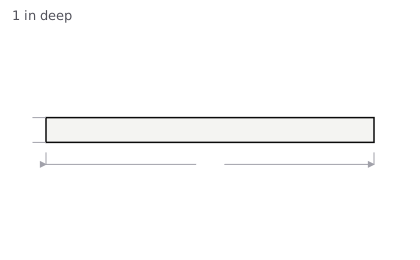
How to calculate board feet
Hardwood is sold by volume, not by the piece. A board foot is 144 cubic
inches — one inch thick, twelve inches wide, one foot long — and every
price a hardwood yard quotes you is per board foot of that volume. The
arithmetic is simple; the part that catches people is that all three
dimensions have to be in inches before you divide, which is the one thing
a board feet calculator has to get right.
Board feet = thickness (in) × width (in) × length (in) ÷ 144
Total = board feet × number of boards
- thickness — nominal thickness in inches, the figure the yard prices on, not the planed measurement
- width — the face width in inches
- length — usually quoted in feet, so multiply by twelve before dividing
- 144 — cubic inches in a board foot: 1 × 12 × 12
Worked example: three 2 × 10 boards, twelve feet long
Length in inches = 12 × 12 = 144 in
Each board = 2 × 10 × 144 ÷ 144 = 20 board feet
Three boards = 20 × 3 = 60 board feet
At $6.50 per BF = $390.00
The middle line is worth pausing on. The 144 in the numerator is the
length in inches and the 144 in the denominator is the definition of a
board foot; they cancel here purely because the board happens to be twelve
feet long. Change the length to ten feet and the coincidence disappears.
Square feet and board feet are not the same kind of thing
This is the question behind most of the confusion, and the answer is
shorter than people expect: a square foot is an area and a board
foot is a volume, so there is no conversion between them until
you name a thickness. Once you have, it is a multiplication.
board feet = square feet × thickness (in)
square feet = board feet ÷ thickness (in)
100 ft² of 4/4 = 100 board feet
100 ft² of 8/4 = 200 board feet
100 ft² of 12/4 = 300 board feet
Same floor. Three times the timber.
Every one of those uses the nominal thickness, because
that is what the yard bills. The dressed thickness is what you can
actually cover with, and the calculator shows both — pick "From square
feet" and it converts either direction.
Why there is no waste allowance on this tool
Every other calculator on this site adds a waste percentage, because the
material is uniform and the losses are predictable. Solid timber is not
uniform. One board is clear and the next has a knot through the middle of
the only length you needed, and the allowance that covers it depends
entirely on the grade you bought and the parts you are cutting.
Twenty to thirty percent over the finished volume is the working figure
for furniture in a decent grade, and it climbs steeply if you are matching
grain across a panel or working around defects in a lower grade. That is a
judgement about your boards, not a constant, so this tool gives you the
honest volume and leaves the allowance to you.
Common mistakes
- Leaving the length in feet. A twelve-foot board is 144
inches. Divide by 144 without converting first and you get one twelfth
of the real figure — the same class of error as leaving slab thickness
in inches.
- Using the planed thickness. A 4/4 board planed to
13/16 in is still sold as one inch. Measuring what arrived rather than
what was quoted understates the bill by about a fifth.
- Applying board feet to sheet goods. Plywood, MDF and
melamine are sold by the sheet, not by volume. Use the cut list
optimizer for those.
- Confusing board feet with lineal feet. Lineal feet
count length alone and ignore thickness and width entirely. Trim and
moulding are sold that way; boards are not.
- Averaging a waney width by eye. On live-edge stock,
find out whether your yard measures at the narrowest point or takes an
average, because the difference on a wide board is real money.
When these numbers do not apply
- Softwood dimensional lumber. A 2 × 4 is priced per
piece or per lineal foot at most yards, and its actual size is 1.5 ×
3.5 in. Board feet are the wrong unit for it.
- Rough-sawn stock you intend to surface. You are billed
on the rough dimensions, so budget the volume you buy rather than the
volume you end up with after planing.
- Timber sold by the cubic metre. Common outside North
America. One cubic metre is roughly 424 board feet, but check whether
the quote is for sawn or finished volume before converting.
- Veneer and thin stock. Anything under about 3/8 in is
usually sold by area or by the sheet, because the board foot becomes an
awkward unit at that thickness.
Board feet in common softwood sizes (actual dimensions)
Computed from actual surfaced dimensions, which is what you measure. Yards selling by the board foot usually price on nominal size instead — a nominal 2 × 4 × 8 is 5.33 board feet on that basis.
Common questions
How do you convert square feet to board feet?
Multiply the square feet by the thickness in inches. A board foot is one square foot of surface one inch thick, so 100 square feet of 4/4 stock is 100 board feet, and the same area in 8/4 is 200. Going the other way, divide: 200 board feet of 4/4 covers 200 square feet. The thickness is not optional — a board foot is a volume and a square foot is an area, so there is no conversion between them at all until you say how thick the stock is. Most answers to this online quietly assume one inch and do not mention it. Pick "From square feet" above and it converts either direction.
How do you calculate board feet?
Thickness in inches × width in inches × length in inches, divided by 144. A board foot is 144 cubic inches, which is a piece one inch thick, twelve inches wide and a foot long. The usual shortcut is thickness × width × length in feet ÷ 12, which is the same sum with the length already converted — and mixing the two is how people end up twelve times out. Use nominal sizes, because that is what you are billed on.
Can I enter thickness in quarter notation — 4/4, 8/4?
Yes, type it exactly as it is written. Quarter notation is a fraction and means what it says: four quarters of an inch is one inch, eight quarters is two, five quarters is an inch and a quarter. The thickness field reads fractions, so 8/4 and 2 give the same answer. Quarter notation describes rough thickness before surfacing, which is also what a hardwood yard charges board footage on — so leave the size basis on nominal when you use it.
What exactly is a board foot?
A board foot is a volume, not an area: 144 cubic inches, which is a piece one inch thick, twelve inches wide and one foot long. Because it is a volume, a 1 × 12 × 1 ft board and a 2 × 6 × 1 ft board are both exactly one board foot despite looking nothing alike.
Do I use the nominal size or the actual size?
Either — the toggle above takes both and shows you both figures, which is the point. Lumber is billed on its nominal size and delivered dressed, so a nominal 2 × 6 is charged as 8 board feet at eight feet long but contains 5.5 board feet of actual wood. Enter whichever number is in front of you and the calculator resolves the other from the published dressed sizes.
How much smaller is a 2x6 than 2 by 6 inches?
It measures 1½ by 5½ inches — about 31 percent less wood than the nominal figure. That is not a manufacturing tolerance, it is the published standard: NIST PS 20-10 Table 3 sets the minimum dressed dry size for every nominal dimension, and it is cited at the bottom of this page. A nominal 8 inch width dresses to 7¼, a 10 to 9¼, a 12 to 11¼ — the shortfall grows in absolute terms as the board gets wider, though it shrinks as a percentage.
Am I being overcharged, then?
No, but you should know which number you are looking at. Board feet are a billing unit and the whole trade prices on nominal size, so everyone is quoting the same basis. The problem is planning: if you work out how much stock a project needs from nominal board feet, you will come up short, because the wood that arrives is the dressed size. This calculator shows both so you can price the order and plan the cuts without switching tools.
Can I price a whole cutting list at once?
Yes — switch to the cutting list option and add a row per size. Board feet add without rounding, because timber is sold by the board foot itself rather than by the piece, so a list really is just a sum. What it saves you is the bookkeeping: every line dresses differently, a nominal 1x8 losing a quarter inch of thickness where a 2x6 loses a half, and doing that across six sizes by hand is where people lose track. Each line stays on the ticket so you can check one rather than trusting a total you cannot audit.
Why is my board foot count different from the yard ticket?
Three things account for almost every discrepancy. Rough-sawn stock is measured before planing, so it gains volume on paper. Widths on live-edge or waney boards are taken at the narrowest point by some yards and averaged by others. And many yards round each board up to the next quarter foot of length before pricing.
What is 4/4, 5/4 and 8/4?
Quarters are the hardwood trade’s way of writing thickness in quarter-inches: 4/4 is one inch, 5/4 is an inch and a quarter, 8/4 is two inches. They describe the rough thickness before surfacing, which is why a board sold as 4/4 arrives closer to 13/16 in once it has been planed on both faces.
Should I add extra for waste?
Yes, and more than you would for sheet goods. Solid timber carries defects, splits and bark that sheet material does not, and every board has to be cut to clear them. Twenty to thirty percent over the finished volume is normal for furniture work, and more if you are matching grain or colour across a panel.
Does this work for metric timber?
You can enter millimetres or centimetres and the tool converts before calculating, but the answer is still in board feet, because that is the unit hardwood is priced in. If your supplier quotes cubic metres, one cubic metre is about 424 board feet.